MakarovSuites
English
EnglishDeutschРусскийУкраїнськаFrançaisEspañolItalianoPolski
Contact & licences

Physics

Ion traps: Penning and Paul

Follow one ion in Penning and Paul quadrupole traps. Resolve cyclotron and axial motion, RF micromotion, stroboscopic samples and loss of confinement.
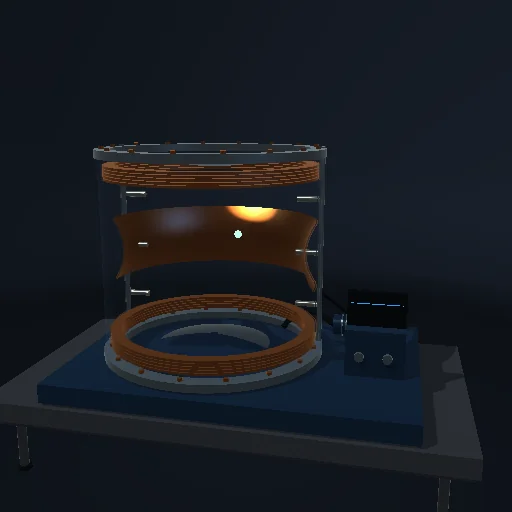
Ion traps: Penning and Paul — Actual application image
Actual application image

Try this

Dimensionless ideal fields. Loss at a virtual spherical aperture, radius 1.2. Disabling confinement removes B or RF; the DC electric field remains.

Equations used in the module
Equations
Penning: x″ = x/2 + ωc y′; y″ = y/2 − ωc x′; z″ = −z
ω± = (ωc ± √(ωc² − 2))/2
Paul: x″ = −Ω²(a − 2q cos Ωt)x/4; y″ likewise; z″ = +Ω²(a − 2q cos Ωt)z/2

Related experiments

Back to catalogue
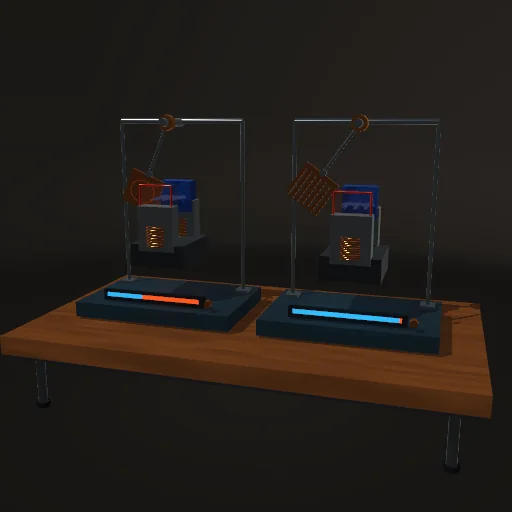
Eddy-current brake — Actual application image

Physics

Eddy-current brake

A conducting pendulum loses mechanical energy to induced current. Compare solid and slotted plates using a lumped-loop electromagnetic model with an explicit heat budget.

Rattleback — Actual application image

Physics

Rattleback

The averaged Garcia–Hubbard model shows energy exchange between spin, pitch and roll. Change skew and spin direction to observe asymmetric reversal times.

Bridge flutter — Actual application image

Physics

Bridge flutter

Wind couples bending and torsion in an illustrative bridge-section model. Compare subcritical decay with flutter above the calculated linear threshold and nonlinear amplitude limitation.