Physics
Kundt's tube
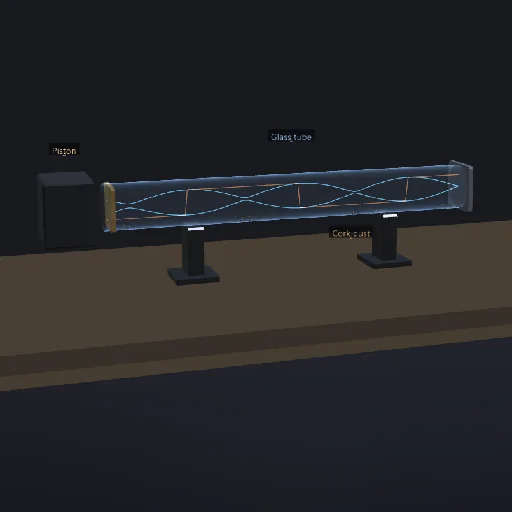
A piston drives a glass tube; cork dust collects at the standing wave's displacement nodes, and the pile spacing measures the speed of sound.
What happens
A piston shakes a closed glass tube, and the cork dust on the floor drifts to wherever the air stands still - the displacement nodes. Snap to a resonance and the piles line up half a wavelength apart, and the panel reads the speed of sound off the dust itself: c = 2·d·f, which is Kundt's measurement of 1866. Between resonances the standing wave is too weak to beat the shaking, the dust stays loose, and that is the point: resonance is something the tube does, not something the slider claims.
Equations used in the module
Equations
∂p/∂t = −ρc²∂v/∂x
∂v/∂t = −(1/ρ)∂p/∂x
f_n = nc/(2L); λ_n = 2L/n