MakarovSuites
English
EnglishDeutschРусскийУкраїнськаFrançaisEspañolItalianoPolski
Contact & licences

Physics

Water: dipoles and hydrogen bonds · 3D

48 polar molecules move and rotate in three dimensions. Explore hydrogen-bond indicators, thermal motion and alignment in an electric field.
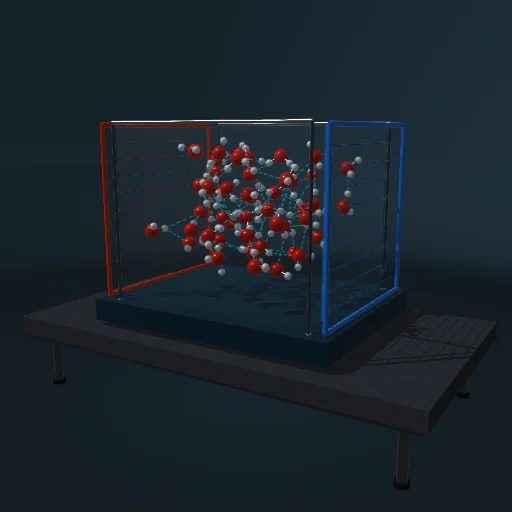
Water: dipoles and hydrogen bonds · 3D — Actual application image
Actual application image

Try this

Red oxygen and white hydrogen form 48 rigid molecules. Change the field axis or reverse its direction. Cyan dashed lines mark geometric hydrogen-bond candidates; amber arrows show molecular dipoles.

Equations used in the module
Equations
U = Σ qi qj/√(rij² + ε²) + 4εLJ[(σ/rOO)^12 − (σ/rOO)^6]
τ = Σ (rsite − rO) × Fsite; Tkin = Σ m v²/(3 N kB)
qO = −0.84; qH = +0.42; HOH = 104.5°
3D rigid rotors; normalized quaternions; Langevin thermostat
Reduced units and isotropic rotor inertia; geometric bond indicators
Related experiments

Back to catalogue
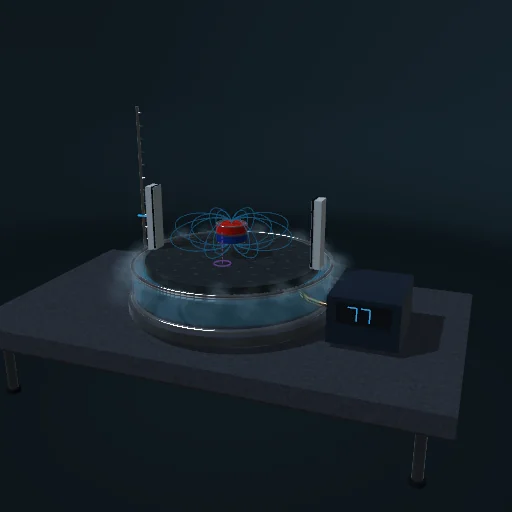
Superconducting levitation — Actual application image

Physics

Superconducting levitation

Compare ideal Meissner repulsion with an optional field-cooled pinning well. Disturb a levitating magnet and warm the sample through its critical temperature.

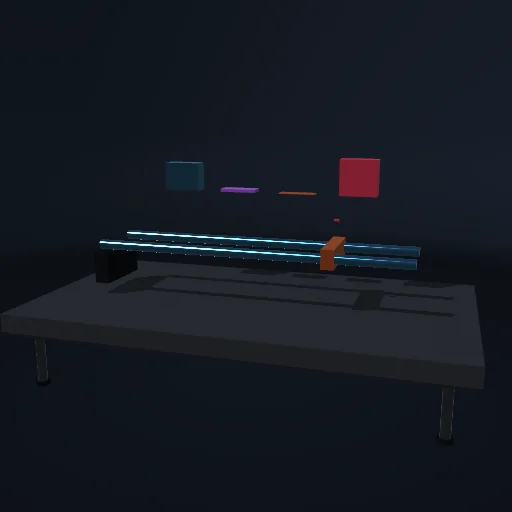
Rail gun — Actual application image

Physics

Rail gun

A capacitor-driven rail launcher couples current, changing inductance and armature motion. Inspect force, speed, Joule losses and the complete energy balance in slow motion.

Kelvin's water dropper — Actual application image

Physics

Kelvin's water dropper

A reduced Kelvin water-dropper circuit amplifies charge through crossed induction. Explore growth, leakage, energy storage and repeated spark discharge powered by falling water.