Astronomy
Cepheid period-luminosity
A pulsating photosphere, measured nights and the cosmic distance ladder. Recover a period from a phase fold, distinguish mean flux from mean magnitude, and see how dust biases distance.
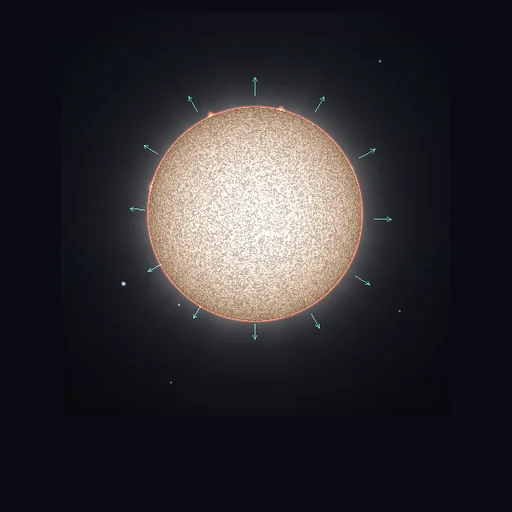
What happens
Classical Cepheids, V band; historical Feast–Catchpole (1997) calibration. A synthetic three-harmonic curve, not a real catalogue. Fits use only acquired nights. Distance is conditional on period, extinction and calibration; no distance error bar is claimed. The star is a schematic 550 nm blackbody proxy with prescribed radius, not a pulsation or atmosphere calculation. V flux and bolometric output are distinct. Glow, granulation and display brightness are illustrative; distance does not resize this close-up.
Equations used in the module
Equations
M_V = −2.81 log₁₀ P − 1.43
⟨V⟩_I = −2.5 log₁₀ ⟨10^(−0.4 V)⟩
d = 10 pc · 10^((⟨V⟩_I − M_V − A_V − ΔM)/5)
B_λ(T) ∝ 1 / (exp(hc/(λkT)) − 1)
L_bol ∝ R² T⁴