Physics
Density anomaly of water
Ice floats because its lattice is open. Warm the water and the network breaks: density rises to a maximum at 4 °C, then falls again.
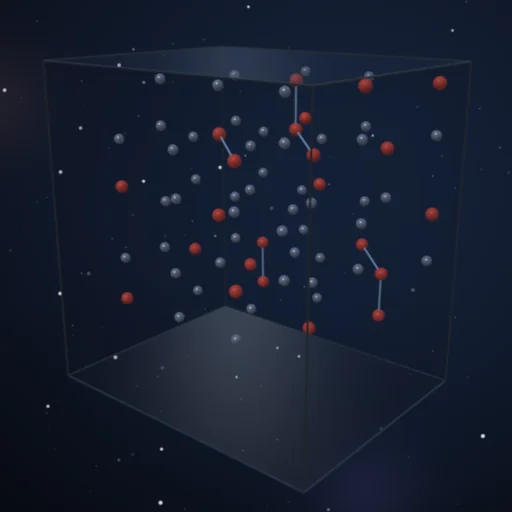
What happens
The open structure here is not a model - it is the crystallography of ice Ih, and the density that comes out of the lattice constants is 920 kg/m³ against the measured 917. The liquid is Roentgen's two-structure picture: molecules sit either in that open network or in a collapsed, denser arrangement, with a Boltzmann equilibrium between them. Warming breaks bonds and makes the mixture denser; warming also expands both structures. Where the two effects cross is 4 °C, and it falls out rather than being put in.
Equations used in the module
Equations
ρ(T) peaks at 3.98 °C
ice: open lattice, ρ = 0.917 g/cm³ → floats
warming breaks the network: ρ rises, then thermal expansion wins
seawater (UNESCO 1983):  ρ(T, S) at 1 atm;  T_max = 3.98 °C at S = 0, 1.86 at S = 10, −0.30 at S = 20, none past S = 24.5 where it meets the freezing point −0.0575 S + …
the lake:  40 layers, conduction 1.4e-7 m²/s, surface exchange 25 W/m²K, convective adjustment (no lighter water under heavier), Stefan ice dh/dt = k(T_f − T_air)/(ρ_i L h)
measured (twin):  15 °C lake, air −10 °C: the column cools as one to 4.9 °C by day 10; day 30: ice 47 cm, 0 °C under it, 4.0 °C from 2 m to the bottom;  seawater at 35: −1.92 °C top to bottom, no floor
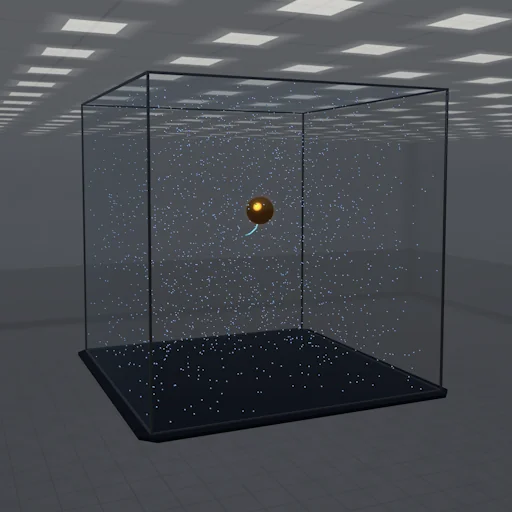
the cube:  ρ_ice/ρ_water = 91.7 % under fresh water at 4 °C, 89.2 % under seawater;  a litre of fresh water freezes into 1.091 litres