Physics
Nuclear power plant
Follow energy from a controlled chain reaction through three water circuits to the electrical grid. Explore xenon, shutdown and cooling failures.
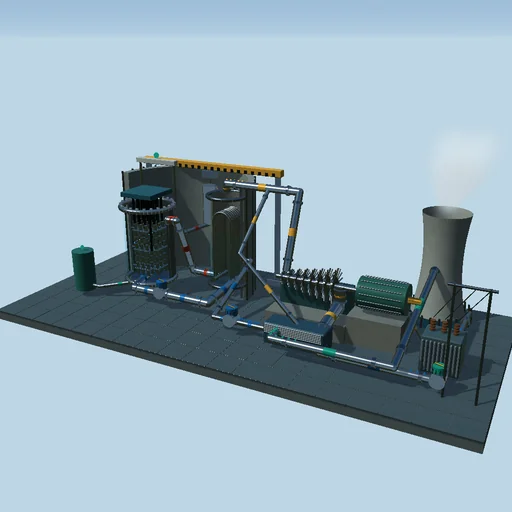
What happens
The fuel heats pressurized water. Heat crosses the steam generator into a separate circuit; steam drives the turbine, and a third circuit cools the condenser. Control rods absorb neutrons. An emergency shutdown stops the chain reaction rapidly, but radioactive decay still heats the fuel. Iodine continues to produce xenon after shutdown, so the strongest neutron poisoning comes later. Watch the hours pass, then compare cooling with and without the backup system.
Try this
Start at steady power. Change the target or move the rods manually, then follow heat and electricity. Select a fault to test the automatic protection. The fast xenon experiment shuts down the reactor and accelerates physical time; it does not alter the decay constants.
The model and its limits
Generic educational PWR: lumped temperatures, point kinetics and approximate steam cycle. No spatial xenon oscillations, fuel chemistry or radiation-release calculation. Damage is a qualitative index. Coloured tracers and the slowed turbine reveal flows and motion; they are visual aids.
Equations used in the module
Equations
n' = ((ρ − β)/Λ)·n + Σ λ_i C_i
I' = λ_I·(n − I)
X' = (λ_X + b)·(0.95 I + 0.05 n) − (λ_X + b n)·X
C_T·T' = Q_in − Q_out
E_shaft' = P_turbine − P_load − P_friction