Physics
Compton scattering
A photon hits a free electron and comes off with less energy and a longer wavelength. The shift depends on the angle and not on the energy.
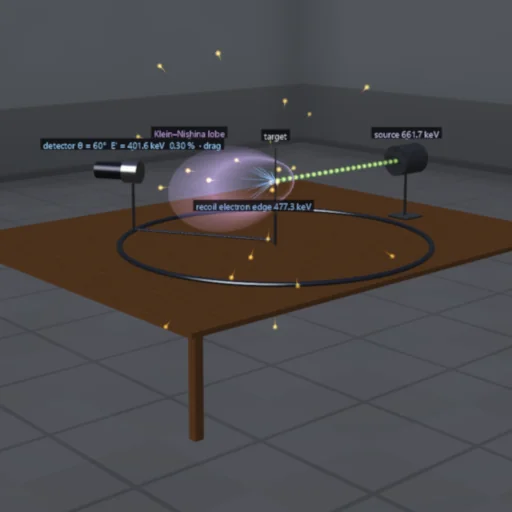
What happens
Three arrows that close into a triangle: the incident photon, the scattered one, and the electron. Their lengths are momenta, so the closing is the physics. The wavelength shift is the Compton wavelength times (1 - cos theta) and does not depend on the incident energy at all - a classical wave would have given no shift whatever. The violet lobe is Klein-Nishina: how likely each angle is, forward-leaning and more so as the energy rises. Fire photons and the histogram grows the shape a real detector sees, with the cliff at the Compton edge where the electron takes the most it can. Here the photons fly one at a time and scatter into a CONE, polar angle from Klein–Nishina and azimuth anywhere; the detector on the arm sees only what lands in its own six-degree cone, its spectrometer grows a peak at E′(θ) that moves when you drag the arm, and its count rate climbs as you swing it forward - that ratio is the lobe made of photons.
Equations used in the module
Equations
λ′ − λ = (h/m_e c)·(1 − cos θ) = 2.4263 pm·(1 − cos θ)
E′ = E / (1 + (E/m_e c²)·(1 − cos θ))
cot φ = (1 + E/m_e c²)·tan(θ/2)
dσ/dΩ = ½r₀²·(E′/E)²·(E′/E + E/E′ − sin²θ)