Physics
Mass spectrometer
A ruler that reads mass off a position: the radius carries the square root of the mass, so every mass difference arrives halved.
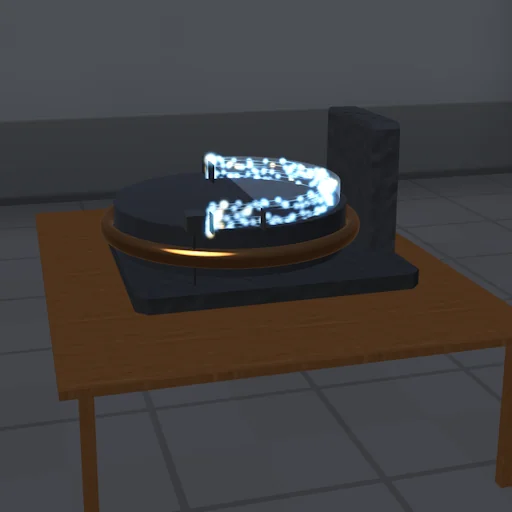
What happens
The voltage gives every ion the same ENERGY, not the same speed, so a heavy ion arrives slower; the magnet then bends by momentum. The two do not cancel, and what comes out is r = sqrt(2Vm/q)/B - a radius carrying the square root of the mass. Differentiate it and you get dr/r = ½ dm/m: every relative mass difference arrives at the plate HALVED. Uranium is not hard because it is heavy. It is hard because three parts in 235 is a small number before the half is taken. Narrow the slit and the arcs and the lines come apart together, because both come from that one number. The plate here fills up one ion at a time, each with the source's own faults - displaced along the slit, tilted a little - and the lines grow where they land: a rare isotope is rare because its line takes a while to appear. Let a share of the ions carry two charges and each lands at r/√2, reading as half its mass: 40Ar 2+ sits exactly on 20Ne 1+. A spectrometer reads m/z, not m.
Equations used in the module
Equations
qV = ½mv²
r = √(2Vm/q) / B
dr/r = ½·dm/m
m/Δm = r/s