Physics
Cherenkov radiation
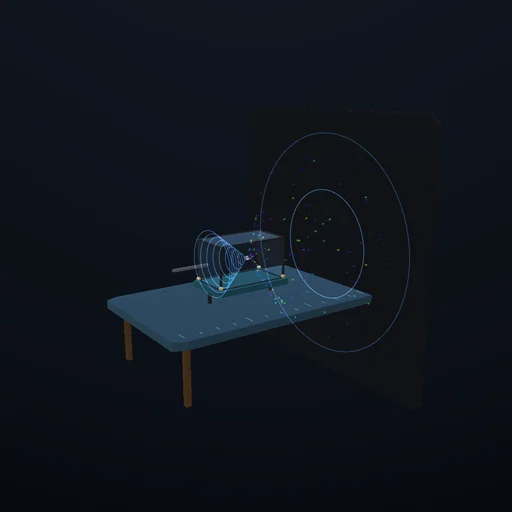
An optical sonic boom: a cone of blue light trailing a particle that outran the light in the medium.
What happens
Nothing outruns light in vacuum, but light in water crawls at three quarters of its vacuum speed and a muon from the sky does not slow down to match. What follows is a cone at an angle that says exactly how fast the particle was going - cos θ = 1/(βn) - and that is why a tank of water with photomultipliers around it is a spectrometer. Below threshold there is NO light: not a faint cone, not a dim ring, nothing. Above it the cone opens fast, four degrees on the first per cent of energy, and settles toward the widest angle the medium can make - 41.39 degrees for water. The yield is about 340 photons a centimetre, which sounds like plenty until the ring arrives a metre across. On the bench the particle sheds photons as it crosses the radiator, each at the cone angle with an azimuth and a wavelength from Frank–Tamm, and they land on a detector plane: the ring BUILDS, blue because the spectrum is 1/λ², and as wide as the radiator because light born at the entrance has further to spread than light born at the exit.
Equations used in the module
Equations
cos θ = 1/(βn)
β_thr = 1/n
d²N/(dx dλ) = (2πα/λ²)·sin²θ = (2πα/λ²)·(1 − 1/(βn)²)