Physics
Alpha decay
Twenty-four decades of half-life out of a factor of two in energy, because the tunnelling probability sits in an exponent.

What happens
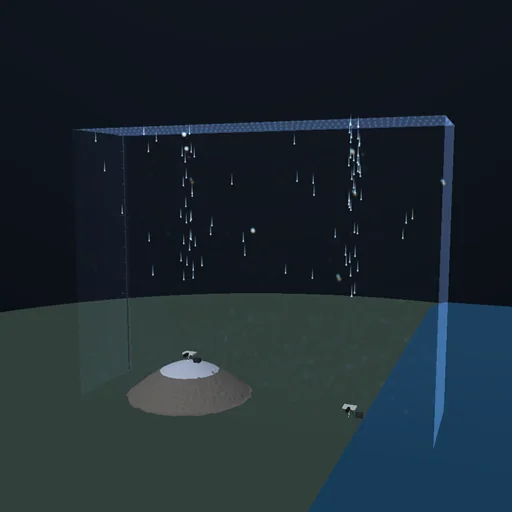
Po-212 emits an 8.95 MeV alpha and lives 0.3 microseconds. Th-232 emits 4.08 MeV and lives fourteen billion years. Rather more than twice the energy, and 10^24 times the lifetime - nothing classical bends like that. Gamow's answer was that the alpha does not go OVER the barrier but THROUGH it, and a tunnelling probability sits in an exponent. Move the energy slider one per cent and watch the lifetime double. The model is uniformly fast by a factor of 461 and its residual wanders only a quarter of a decade across all twenty-four: a flat residual is a missing CONSTANT, not a broken shape, and the constant is the chance that an alpha was preformed inside at all. Between escapes the alpha knocks on the wall of the well - ten to the twenty-first times a second in reality, slowed here so you can see it - and one knock in ten to the many gets through; the count is on the panel. Grab the bright ring at the turning point and pull the energy up: the barrier thins and the half-life drops by decades under your hand.
Equations used in the module
Equations
2G = (2/ħ)·√(2μ/E)·Z₁Z₂e²·[arccos√x − √(x(1−x))],   x = R/b
b = 2Z₂e²/E
P = exp(−2G),   λ = f·P,   t½ = ln2 / λ
log₁₀ t½ ≈ a·Z/√E + b   (Geiger–Nuttall)