Physics / Astronomy / Earth
Aurora (magnetosphere)
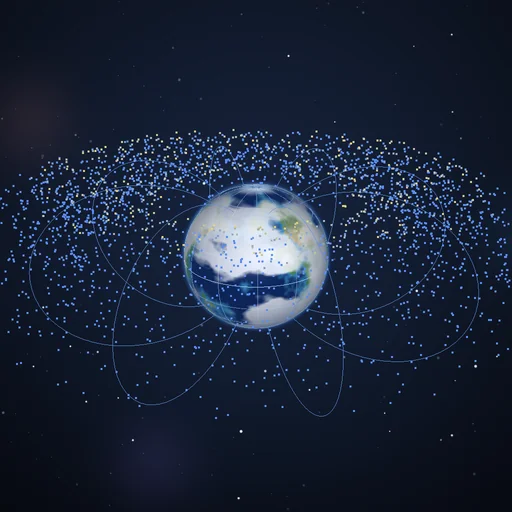
A charged particle on a real dipole field line: it either mirrors before reaching the atmosphere, or precipitates - decided entirely by its pitch angle.
What happens
A planet's magnetic field is (to a good approximation) a plain dipole - the same shape as a bar magnet's, just enormous. A charged particle trapped on one field line spirals along it, and as the field strengthens toward the poles, the same conservation law that keeps a figure skater's arms-in spin fast forces the particle's spin around the field line to speed up too - which, since its total speed never changes, means its motion ALONG the field line has to slow down. Launched mostly sideways to the field (a steep pitch angle), it slows to a stop and reverses long before reaching the atmosphere - a magnetic mirror. Launched mostly along the field (a shallow pitch angle), there is not enough sideways motion to convert, and it rides the field line straight down into the atmosphere - precipitation, and this is literally what draws the aurora down to a ring around each pole.
Equations used in the module
Equations
μ = v_perp² / B   (first adiabatic invariant)
mirror where B = B₀ / sin² α₀
dipole:  B ∝ √(1 + 3 sin² λ) / r³;  loss cone → aurora
loss cone at the equator of shell L:  sin²α_lc = 1/L³ / √(4 − 3/L):  16.3° at L = 2, 8.4° at L = 3, 5.3° at L = 4;  launched over 2°…88°, the share inside is (α_lc − 2)/86: 7.5 % at L = 3
the oval:  landings binned 64 × 32 on the sphere, fading with τ = 12 s;  green 557.7 nm low, red 630.0 nm high, from the same map