MakarovSuites
English
EnglishDeutschРусскийУкраїнськаFrançaisEspañolItalianoPolski
Contact & licences

Astronomy

Building an image one photon at a time

Lengthen an exposure and collect photons from a faint spiral galaxy. Compare signal, sky background and read noise in the signal-to-noise budget.
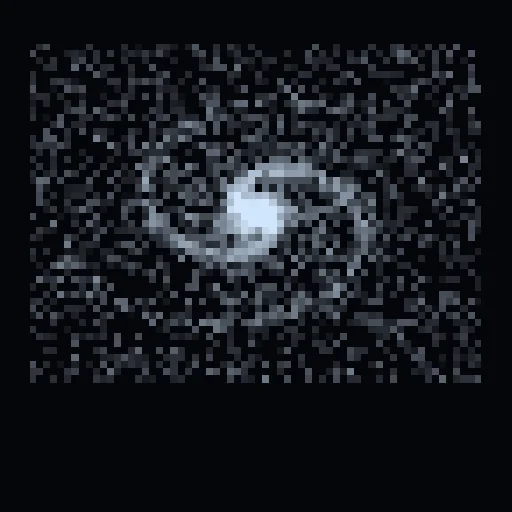
Building an image one photon at a time — Actual application image
Actual application image

The model and its limits

Poisson source/sky statistics and Gaussian read-noise variance for a fixed aperture. The displayed photon positions are reproducibly sampled from an illustrative galaxy profile.

Equations used in the module
Equations
SNR = S t/√[(S+B)t+σ_read²]; σ_read ≥ 0
Related experiments

Back to catalogue
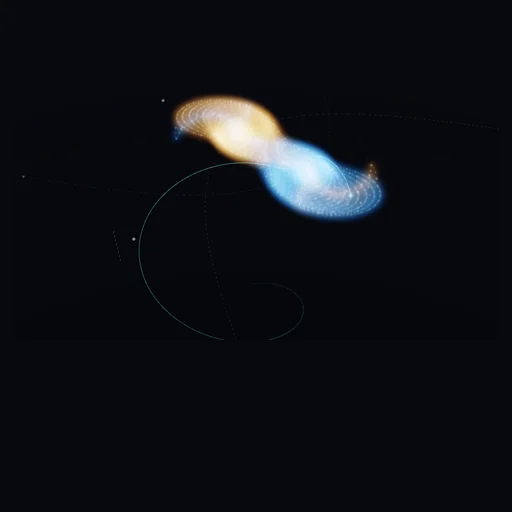
Galaxy collision — Actual application image

Astronomy

Galaxy collision

Explore a galaxy encounter: tilt the discs, follow a star, and compare opposite rotations. Tidal bridges and tails emerge from test-star trajectories. Optional dark halos and dynamical friction illustrate how the nuclei can coalesce.

Galaxy rotation curve — Actual application image

Astronomy

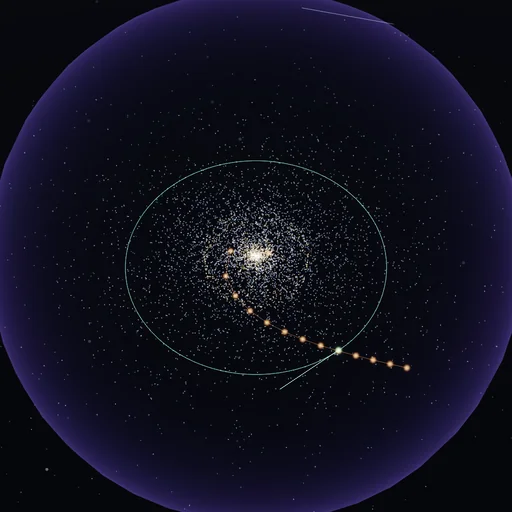
Galaxy rotation curve

The curve that should fall and does not: dark matter as a measurement. A galaxy's stars orbit at the speed its mass dictates - a bulge, an exponential disk with Freeman's exact potential, a gas disk - and beyond a few scale lengths that speed must fall like a planet's. Measured curves stay flat. Add a halo, switch it off, compare with the dataset and read χ²; watch a spoke of stars wind into a spiral as the disk turns.