Astronomy
Galaxy rotation curve
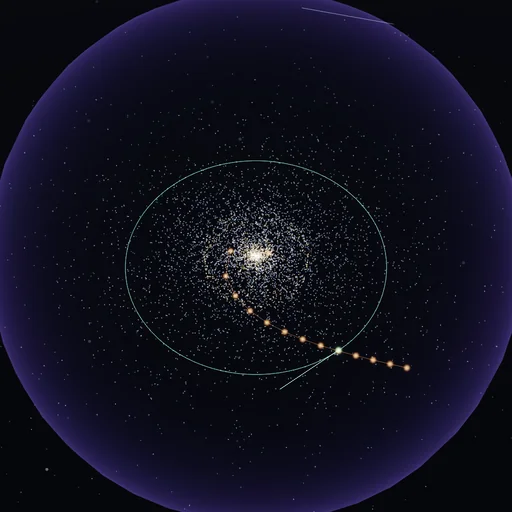
The curve that should fall and does not: dark matter as a measurement. A galaxy's stars orbit at the speed its mass dictates - a bulge, an exponential disk with Freeman's exact potential, a gas disk - and beyond a few scale lengths that speed must fall like a planet's. Measured curves stay flat. Add a halo, switch it off, compare with the dataset and read χ²; watch a spoke of stars wind into a spiral as the disk turns.
What happens
A star's orbital speed is set by the mass inside its orbit. Outside the bright disk that mass stops growing, so the speed should fall as one over the square root of the radius, the way the planets' do. It does not: measured curves run flat to the last gas cloud. Either gravity is wrong or there is mass we do not see - a halo, several times the visible total, extending far beyond the disk. Switch the halo off and the outer galaxy slows; the dataset stays where it was, and χ² says by how much you miss it. The disk is computed as a thin disk (Freeman's potential), not as a sphere; the dataset here is synthetic and says so.
Equations used in the module
Equations
v² = v_b² + v_d² + v_g² + v_h²
bulge: v² = G M r/(r + a)²
disk: v² = 4πGΣ₀R y²[I₀(y)K₀(y) − I₁(y)K₁(y)],  y = r/2R
halo: v² = v∞²[1 − (r_c/r) atan(r/r_c)]