Astronomy
Pulsar
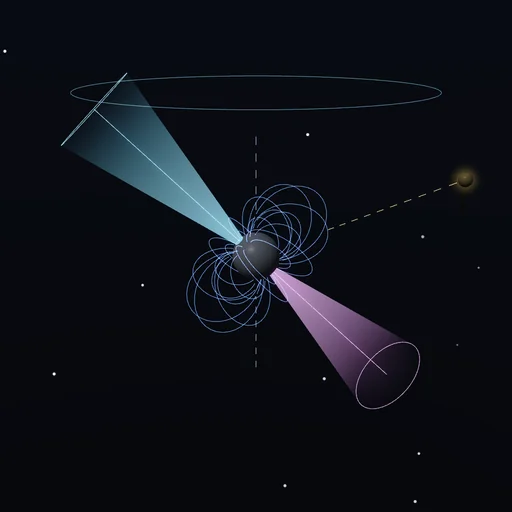
A neutron star with its radio beam tilted from its spin axis is a lighthouse, and whether you see it, how often and for how long is one line of spherical trigonometry: cos θ = cos α cos ζ + sin α sin ζ cos φ. The beam sweeps within ρ of you or it does not; the second pole may sweep past too - the interpulse - and most pulsars are never seen at all, because their beams miss the Earth. Pulse width, duty cycle and the beamed fraction of the sky are measured on the profile and the sky, not quoted.
What happens
A neutron star spinning with a beam of radio waves tilted from its axis - a lighthouse. Whether you see it depends on where you stand: the beam must sweep across your line of sight, and it does so only for observers within the beam's half-width of the tilt. Tilt the beam near 90° and both poles sweep past - two pulses per turn, like the Crab. The pulse width follows from three angles, and the slowing of the spin gives the power the star pours into its nebula. Try the Crab and Vela presets, move the observer, and watch pulses appear and vanish as the beam misses you.
Equations used in the module
Equations
cos θ(φ) = cos α cos ζ + sin α sin ζ cos φ
pulse while θ ≤ ρ;  main pulse iff |ζ − α| ≤ ρ
W = 2 arccos[(cos ρ − cos α cos ζ)/(sin α sin ζ)]
Ė = 4π² I dP/dt/P³,  I = 10³⁸ kg m²