Astronomy
Gravitational lensing
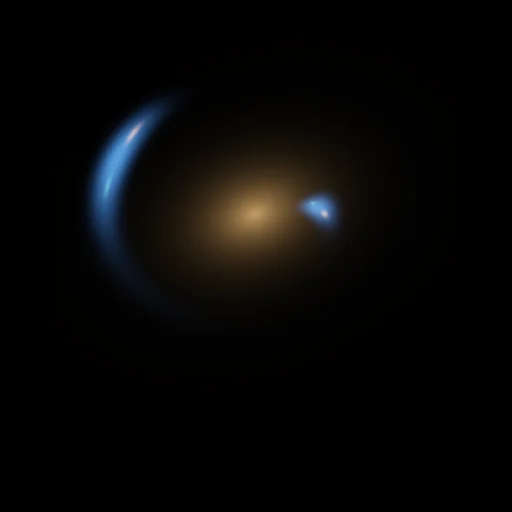
Move a galaxy across a caustic, inspect mirrored images and follow light paths in 3D. Compare a finite star with the ideal point-source limit.
What happens
Move a galaxy across a caustic, inspect mirrored images and follow light paths in 3D. Compare a finite star with the ideal point-source limit.
Thin lens, geometric optics, one point mass or singular isothermal ellipsoid (q ≥ 0.45); no shear, planet, cosmological distance solver, wave optics or strong-field geodesics. SIE image centers are numerical roots; arbitrarily close merging pairs may be unresolved. The circular aligned limit is a continuous ring, not a finite image count. Galaxy source: elliptical Gaussian plus two coloured knots; its full analytic flux normalizes a ±4.5 b image aperture with grid-refinement diagnostics. Sky colours, lens light, star glow and exposure are illustrative. The 3D paths use a schematic Euclidean Ds=2Dl geometry with enlarged transverse angles. Microlensing uses a uniform finite disk, not a limb-darkened star; the point-source curve is only a comparison. Local Galactic distances set θE and tE=RE/v; changing mass/distances holds dimensionless ρ and β fixed. Playback speed is not the physical transverse velocity. B freezes angular lens/source/position; curve B is available for a point lens with a uniform disk and uses the current day scale.
The model and its limits
Thin lens, geometric optics, one point mass or singular isothermal ellipsoid (q ≥ 0.45); no shear, planet, cosmological distance solver, wave optics or strong-field geodesics. SIE image centers are numerical roots; arbitrarily close merging pairs may be unresolved. The circular aligned limit is a continuous ring, not a finite image count. Galaxy source: elliptical Gaussian plus two coloured knots; its full analytic flux normalizes a ±4.5 b image aperture with grid-refinement diagnostics. Sky colours, lens light, star glow and exposure are illustrative. The 3D paths use a schematic Euclidean Ds=2Dl geometry with enlarged transverse angles. Microlensing uses a uniform finite disk, not a limb-darkened star; the point-source curve is only a comparison. Local Galactic distances set θE and tE=RE/v; changing mass/distances holds dimensionless ρ and β fixed. Playback speed is not the physical transverse velocity. B freezes angular lens/source/position; curve B is available for a point lens with a uniform disk and uses the current day scale.
Equations used in the module
Equations
beta = theta - alpha(theta); surface brightness I_image(theta) = I_source(beta(theta))
Point lens: alpha = theta/|theta|^2; A(u) = (u^2+2)/(u sqrt(u^2+4)); exact alignment is a continuous Einstein ring
SIE: psi=sqrt(q^2 x^2+y^2); alpha=(atan(e x/psi), atanh(e y/psi))/e, e=sqrt(1-q^2); analytic circular limit q=1
Signed mu = 1/det(d beta/d theta); negative parity does not mean negative flux
Finite uniform disk: A_fs = integral_disk A(|beta|) d^2 beta / (pi rho^2); A_fs(0)=sqrt(rho^2+4)/rho
Lens-centred polar primitive: integral r A(r) dr = r sqrt(r^2+4)/2; disk-edge angular substitution removes endpoint singularity
theta_E = sqrt(4GM/c^2 * (Ds-Dl)/(Dl Ds)); t_E = Dl theta_E / v_perp; u^2 = u0^2 + ((t-t0)/tE)^2 (local Galactic distances)
SIE angular normalization b is not a total galaxy mass. Sky view and physical light paths have deliberately different display scales.