Physics / Astronomy
Gravitational waves
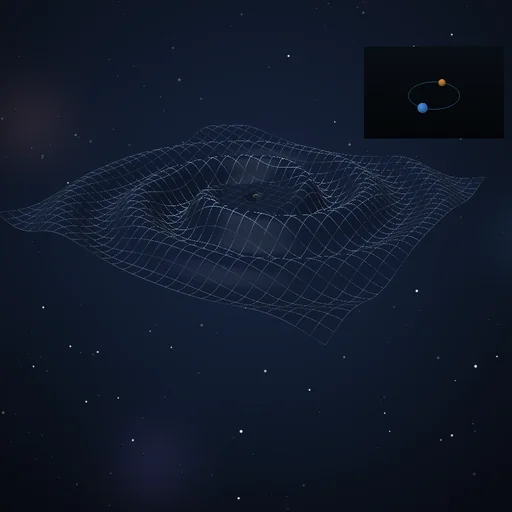
A compact binary spirals in and its quadrupole wave crosses the plane at retarded time: the two-armed spiral tightens as the orbit decays, and the detector trace chirps.
What happens
The sheet is not a rubber membrane: its height at every point is the strain h+ the quadrupole formula gives there, at the moment the wave that reached it left the binary. That retardation is why the pattern is a spiral rather than a breathing ring, why the outer coils are older than the inner ones, and why the plane ahead of the front is still flat and knows nothing yet. As the orbit decays the spiral tightens and the detector trace chirps, frequency and amplitude climbing together: a binary orbiting at f is heard at 2f, because the mass quadrupole returns to itself after half a turn. At the innermost stable orbit the post-Newtonian formula has nothing more to say, so the model stops orbiting and rings down, honestly labelled as a tone rather than numerical relativity.
Equations used in the module
Equations
da/dt = −(64/5) G³ m₁ m₂ (m₁ + m₂) / (c⁵ a³)   (Peters)
f_GW = 2 f_orbit,   h ∝ (G M_c)^(5/3) f^(2/3) / (c⁴ d)
the chirp: f rises as a shrinks