MakarovSuites
English
EnglishDeutschРусскийУкраїнськаFrançaisEspañolItalianoPolski
Contact & licences

Physics / Engineering

Pulley systems

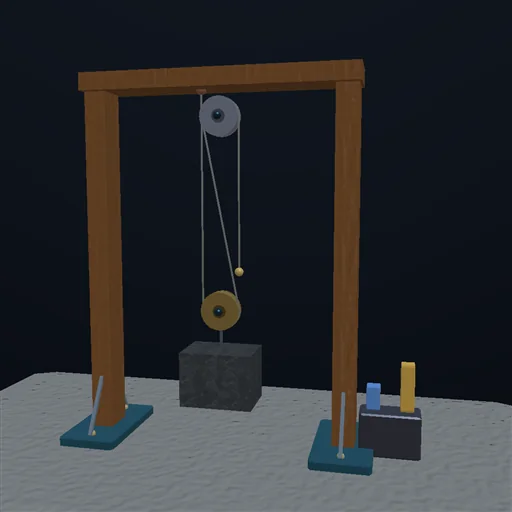
Count the rope segments and you have the mechanical advantage. The work does not change: a machine buys force with distance, never with energy.
Pulley systems — Actual application image
Actual application image

What happens

Count the strands pulling up on the load and you have the mechanical advantage - it is not a number out of a table. Lift the same weight through a fixed block or through a six-fold tackle and the work you put in is identical; the tackle only spreads it over six metres of rope. Two markers rise beside the rig, the load and the rope hauled in, and they separate at exactly the advantage: force is bought with distance and never with energy. Add friction and the work in rises while the work out does not move - efficiency only ever costs.

Equations used in the module
Equations
F = W / n,   n = rope segments holding the load
d_rope = n · d_load   (work is not multiplied)
η = W d_load / (F d_rope)
Related experiments

Back to catalogue
Where is the block? — Actual application image

Physics

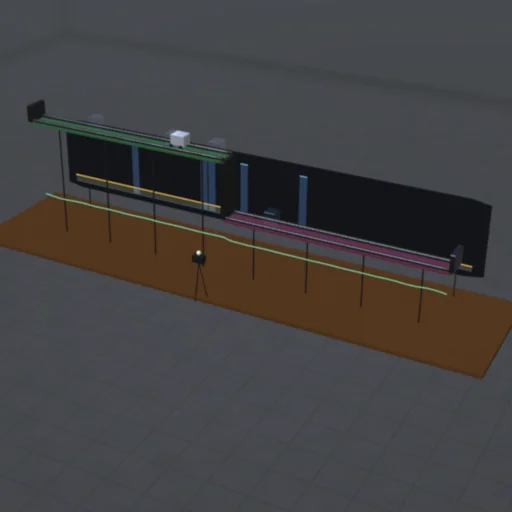
Where is the block?

Random snapshots of a block on a frictionless track build a histogram - and it converges to 1/v, the classical shadow of |psi|^2.

From an LC circuit to a qubit — Actual application image

Physics

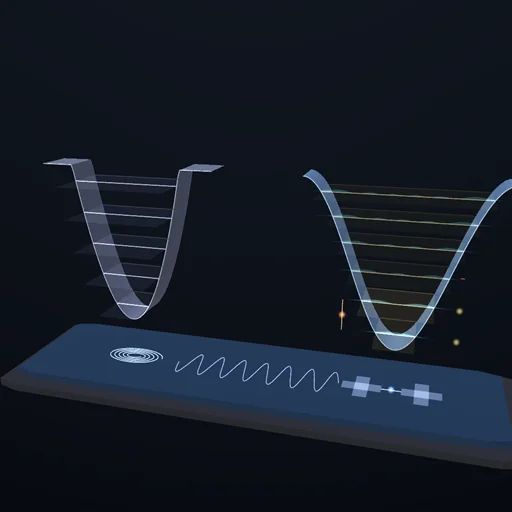
From an LC circuit to a qubit

An LC oscillator has equally spaced levels, so nothing in it can be a two-level system. Swap the inductor for a Josephson junction and the parabola becomes a cosine: the levels crowd together by the anharmonicity α, so a drive on 0→1 leaves 1→2 alone. The other number, the charge dispersion, falls exponentially with √(E_J/E_C) while α falls only linearly - that trade is the transmon. Both numbers come out of the Hamiltonian diagonalised live, and a π pulse shows the leakage the anharmonicity allows.

Aurora (magnetosphere) — Actual application image

Physics / Astronomy / Earth

Aurora (magnetosphere)

A charged particle on a real dipole field line: it either mirrors before reaching the atmosphere, or precipitates - decided entirely by its pitch angle.