Physics
From an LC circuit to a qubit
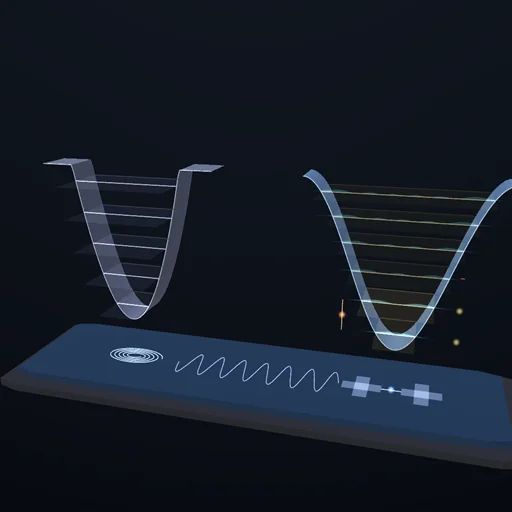
An LC oscillator has equally spaced levels, so nothing in it can be a two-level system. Swap the inductor for a Josephson junction and the parabola becomes a cosine: the levels crowd together by the anharmonicity α, so a drive on 0→1 leaves 1→2 alone. The other number, the charge dispersion, falls exponentially with √(E_J/E_C) while α falls only linearly - that trade is the transmon. Both numbers come out of the Hamiltonian diagonalised live, and a π pulse shows the leakage the anharmonicity allows.
What happens
A superconducting island with a Josephson junction: a pendulum whose levels are not equally spaced. Raise E_J over E_C and the charge noise that plagued the Cooper-pair box dies away exponentially - but the anharmonicity, the gap that lets you address the first two levels without touching the third, shrinks only slowly. That trade is the transmon. Drive it and the third level leaks in when the pulse is too fast for the anharmonicity. Slide E_J/E_C from 1 to 100 and watch the charge dispersion vanish while the levels stay distinct; then drive and see the leakage.
Equations used in the module
Equations
H = 4E_C (n − n_g)² − E_J cos φ
E₀₁ ≈ √(8E_J E_C) − E_C,  anharmonicity α ≈ −E_C
charge dispersion ε₀₁ ~ e^{−√(8E_J/E_C)}
drive: Ω on 0→1, Ω√2 on 1→2, detuned by α