MakarovSuites
English
EnglishDeutschРусскийУкраїнськаFrançaisEspañolItalianoPolski
Contact & licences

Physics

Where is the block?

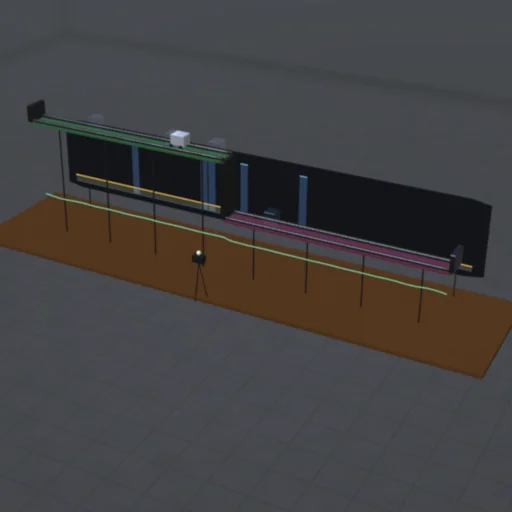
Random snapshots of a block on a frictionless track build a histogram - and it converges to 1/v, the classical shadow of |psi|^2.
Where is the block? — Actual application image
Actual application image

What happens

A random photograph catches the block where it lingers, and it lingers where it is slow. So the probability of finding it goes as 1/v, which on a two-level track is two flat plateaus in the ratio of the speeds. The bars are built from actual snapshots of an actual trajectory, taken at Poisson times so no rhythm of the track can beat with the camera; the line is the theory. This is the classical shadow of |psi|^2 - same question, same shape.

Equations used in the module
Equations
P_classical(x) ∝ 1 / v(x)
|ψ_n(x)|² averaged over levels near E → 1 / v(x)
one level alone oscillates; the average is the shadow
χ²/dof = Σ(O − E)²/E over bins with E ≥ 5, divided by their number − 1;  about 1 when the snapshots are draws from the density, growing with N when they are not
Related experiments

Back to catalogue
From an LC circuit to a qubit — Actual application image

Physics

From an LC circuit to a qubit

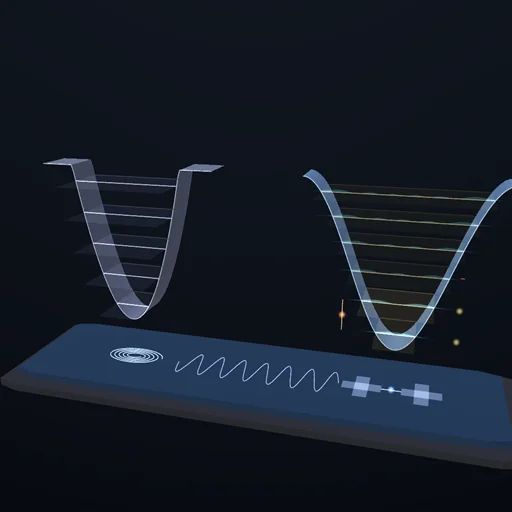
An LC oscillator has equally spaced levels, so nothing in it can be a two-level system. Swap the inductor for a Josephson junction and the parabola becomes a cosine: the levels crowd together by the anharmonicity α, so a drive on 0→1 leaves 1→2 alone. The other number, the charge dispersion, falls exponentially with √(E_J/E_C) while α falls only linearly - that trade is the transmon. Both numbers come out of the Hamiltonian diagonalised live, and a π pulse shows the leakage the anharmonicity allows.

Aurora (magnetosphere) — Actual application image

Physics / Astronomy / Earth

Aurora (magnetosphere)

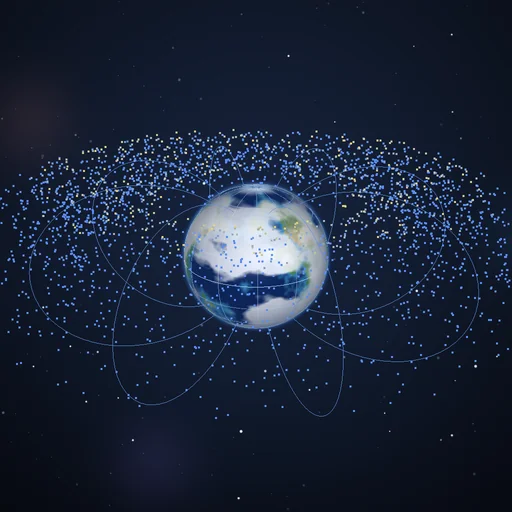
A charged particle on a real dipole field line: it either mirrors before reaching the atmosphere, or precipitates - decided entirely by its pitch angle.

Neural descent — Actual application image

Physics / Math

Neural descent

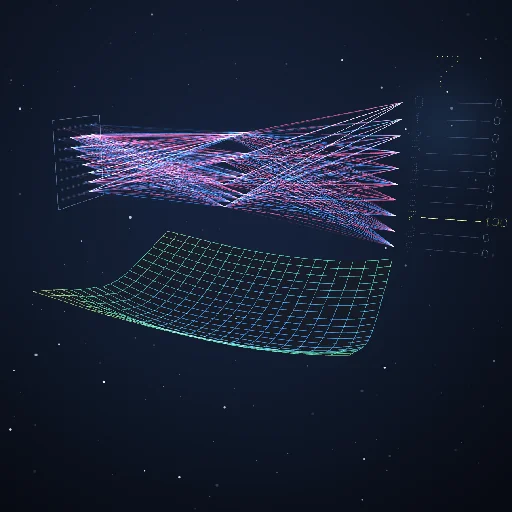
A neural network learns digits live, drawn as physics: the loss landscape in 3D, gradient descent as a ball rolling downhill, momentum as inertia and minibatch noise as temperature.