MakarovSuites
English
EnglishDeutschРусскийУкраїнськаFrançaisEspañolItalianoPolski
Contact & licences

Physics

Electromagnetic induction

Faraday's law live: a magnet falling through a coil induces a current, Lenz brakes the fall for real - plus the copper pipe, a transformer and a generator.

Electromagnetic induction — Actual application image
Actual application image

What happens

Drop the magnet through the coil and watch the flux, the EMF and the current draw themselves - with the circuit closed the magnet lands measurably later, and the energy books balance: what the fall loses, the resistor turns into heat. Grab the magnet with the mouse and wave it yourself, or try the copper pipe, where eddy currents float the magnet down at a crawl. Then switch the magnet for an electromagnet, couple two coils into a transformer, and crank the generator - the harder the lamp loads it, the harder it is to turn.

Equations used in the module
Equations
ε = −N dΦ/dt   (Faraday)
Lenz: the current opposes the change
brake: F = −(B² l² v) / R  →  terminal speed in the pipe
Related experiments

Back to catalogue
Pulley systems — Actual application image

Physics / Engineering

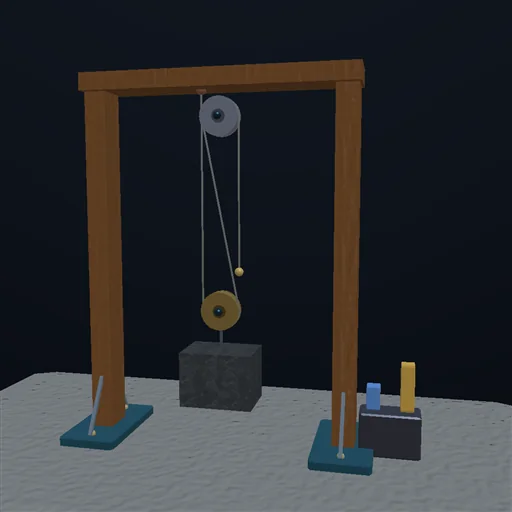
Pulley systems

Count the rope segments and you have the mechanical advantage. The work does not change: a machine buys force with distance, never with energy.

Where is the block? — Actual application image

Physics

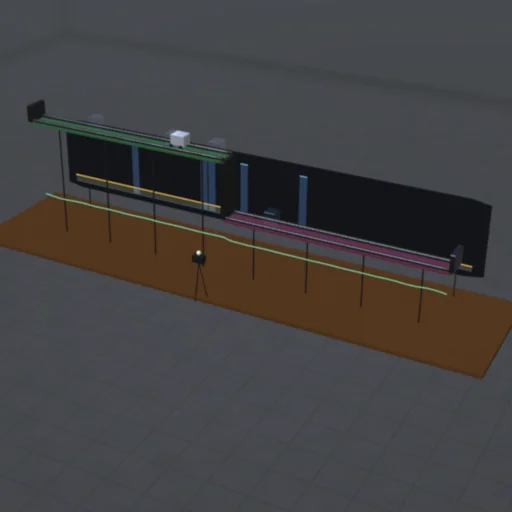
Where is the block?

Random snapshots of a block on a frictionless track build a histogram - and it converges to 1/v, the classical shadow of |psi|^2.

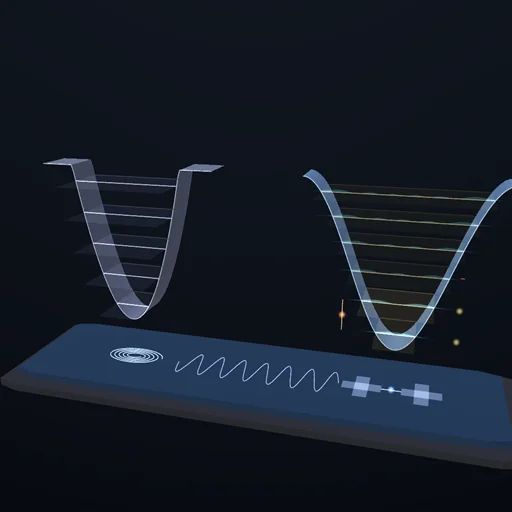
From an LC circuit to a qubit — Actual application image

Physics

From an LC circuit to a qubit

An LC oscillator has equally spaced levels, so nothing in it can be a two-level system. Swap the inductor for a Josephson junction and the parabola becomes a cosine: the levels crowd together by the anharmonicity α, so a drive on 0→1 leaves 1→2 alone. The other number, the charge dispersion, falls exponentially with √(E_J/E_C) while α falls only linearly - that trade is the transmon. Both numbers come out of the Hamiltonian diagonalised live, and a π pulse shows the leakage the anharmonicity allows.