MakarovSuites
English
EnglishDeutschРусскийУкраїнськаFrançaisEspañolItalianoPolski
Contact & licences

Astronomy

Hubble law

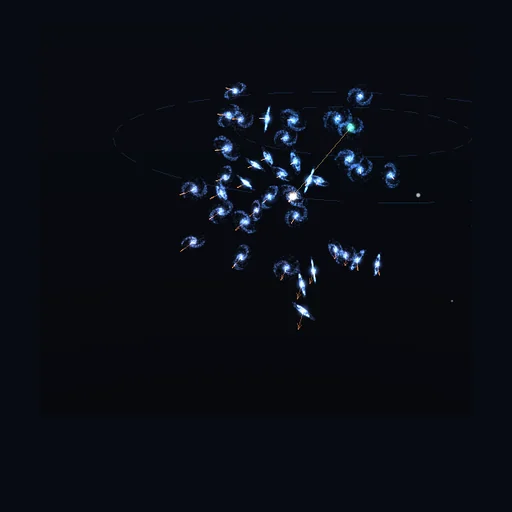
Explore a 3D galaxy survey, measure spectral shifts and build a Hubble diagram. Test peculiar velocities, distance errors and the choice of observer.
Hubble law — Actual application image
Actual application image

What happens

Synthetic low-redshift survey. The map, distances and spectra use the same epoch. Expansion uses a constant H, not ΛCDM, and freezes when you measure. Peculiar velocities are snapshot perturbations, not integrated orbits. Galaxy glyphs are enlarged and keep their size. Auto-fit uses five noisy, identified line centroids; manual z has no calibrated uncertainty. Positive lognormal distance noise has central 68% bars. Through-origin OLS ignores these distance errors and correlated observer motion: its slope is descriptive and RMS is not an H₀ confidence interval. Changing the generator clears the survey; changing sample or distance calibration preserves it.

Equations used in the module
Equations
v_ij = H₀ d_ij + (u_j − u_i)·n
z ≈ v/c,   λ_obs = λ₀ (1 + z)
z_fit = Σ λ₀(λ_measured − λ₀) / Σ λ₀²
H_fit = Σ d_measured (cz_measured) / Σ d_measured²
a(t) = exp(H₀ t)
Related experiments

Back to catalogue
Friedmann scale factor — Actual application image

Astronomy

Friedmann scale factor

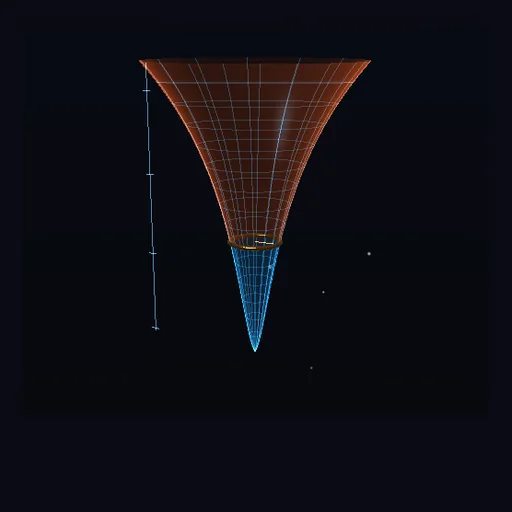
Travel through cosmic time, compare expansion histories, and discover how matter, radiation and vacuum shape expansion, collapse or a bounce.

Pulsar — Actual application image

Astronomy

Pulsar

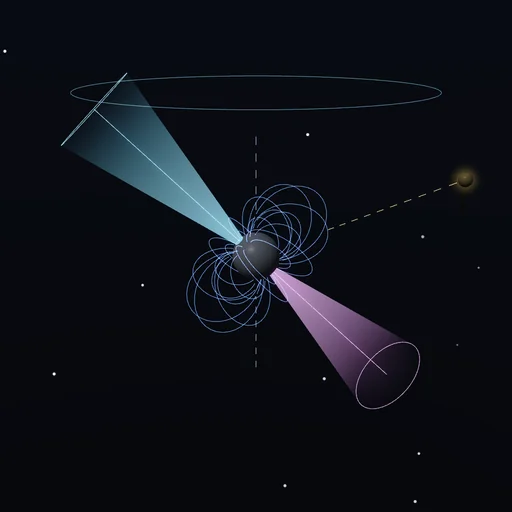
A neutron star with its radio beam tilted from its spin axis is a lighthouse, and whether you see it, how often and for how long is one line of spherical trigonometry: cos θ = cos α cos ζ + sin α sin ζ cos φ. The beam sweeps within ρ of you or it does not; the second pole may sweep past too - the interpulse - and most pulsars are never seen at all, because their beams miss the Earth. Pulse width, duty cycle and the beamed fraction of the sky are measured on the profile and the sky, not quoted.

Gravitational waves — Actual application image

Physics / Astronomy

Gravitational waves

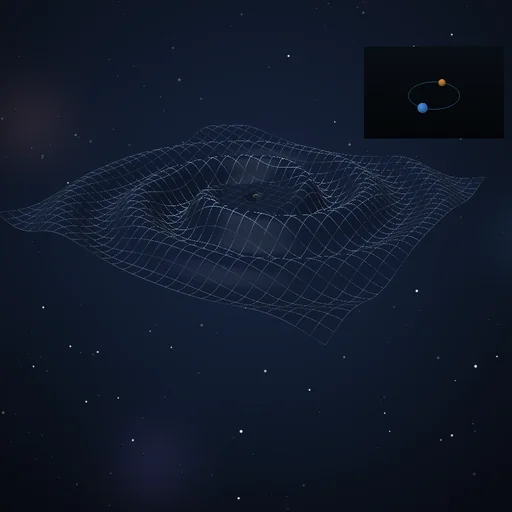
A compact binary spirals in and its quadrupole wave crosses the plane at retarded time: the two-armed spiral tightens as the orbit decays, and the detector trace chirps.