Astronomy
Friedmann scale factor
Travel through cosmic time, compare expansion histories, and discover how matter, radiation and vacuum shape expansion, collapse or a bounce.
What happens
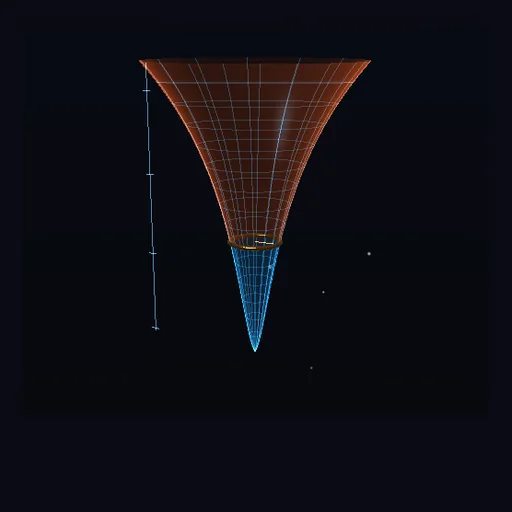
Homogeneous FLRW with non-negative matter, radiation and constant vacuum energy; curvature follows closure. Today is the expanding a=1 branch. Only its connected allowed history is integrated. Simple roots give a turn or bounce; near-double roots are marked critical. Singular endpoints do not give finite H or q. The history sculpture is a diagram, not a boundary or embedding of the universe. The local galaxy lattice does not depict spatial curvature. Enlarged fixed-size galaxy symbols represent comoving markers even at early times; galaxy formation is not simulated. Proper separations scale with a; bound objects do not. The camera can pull back automatically; numerical distances remain physical. No inflation, structure growth, perturbations or ray tracing. Reference B is immutable and drawn only inside its own calculated interval.
Equations used in the module
Equations
H²/H₀² = Ω_r/a⁴ + Ω_m/a³ + Ω_k/a² + Ω_Λ
Ω_k = 1 − Ω_r − Ω_m − Ω_Λ
a″ = Ω_Λ a − Ω_m/(2a²) − Ω_r/a³   [τ = H₀t]
q = −a a″ / a′²
1 + z = a_obs/a_em,   E_photon ∝ 1/a