Physics
Laser and discharge
Pump a three-level medium past its threshold and watch stimulated emission take over; then race electrons down a discharge tube into the Franck-Hertz dips.
What happens
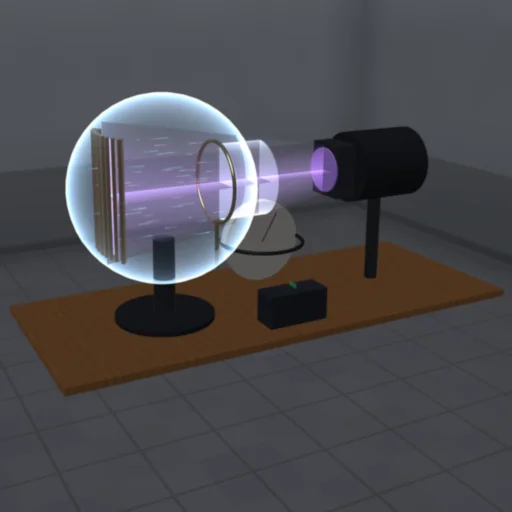
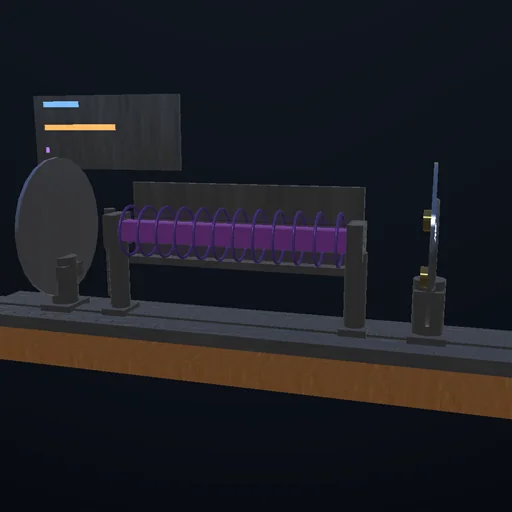
Turn up the flash pump and the rod between the mirrors stays quiet - until the closed-form threshold, where the photon count explodes, rings through relaxation oscillations, and settles into a beam that brightens linearly with pump while the population bars show the gain clamped exactly at the mirror loss. Tick the two-level checkbox and the same pump fails forever: no inversion without a third level. In the discharge tube, electrons surf the field and flash violet, blue and red at exactly the level differences - no glow at all below 4.9 volts - while the scanned collector current carves the Franck-Hertz dips 4.9 volts apart.
Equations used in the module
Equations
dN₂/dt = R_pump N₁ − (A + B I) N₂   (three levels)
gain when N₂ > N₁;  threshold when gain = loss
I grows by stimulated emission: one photon in, two identical out