Physics
Photoelectric effect
Light knocks electrons out of a metal: stopping voltage, the red limit, and measuring Planck constant from the slope - intensity cannot do what frequency does.
What happens
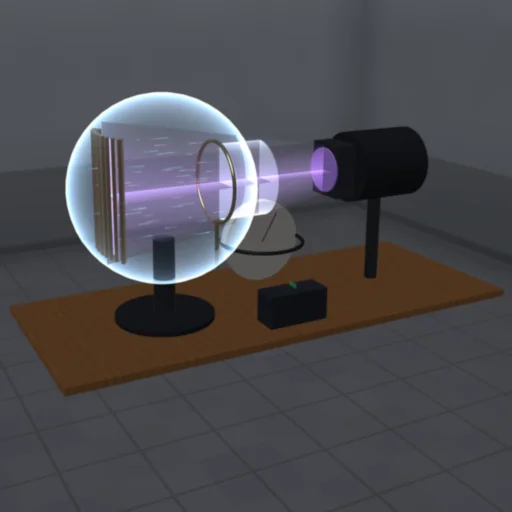
Einstein in a vacuum tube: each photon may free one electron with energy up to hν − W. Slide the wavelength and the electrons fly harder; slide the intensity and there are merely MORE of them - and below the red limit even a blinding lamp does nothing. Bias the anode negative until the current dies: that stopping voltage against frequency is a straight line, and its slope is Planck constant over e. Swap the cathode metal and only the intercept moves.
Equations used in the module
Equations
K_max = h f − W,   e V_stop = K_max
red limit:  f₀ = W / h
slope of V_stop against f gives h/e;  intensity sets the current, not K