Physics
Davisson-Germer
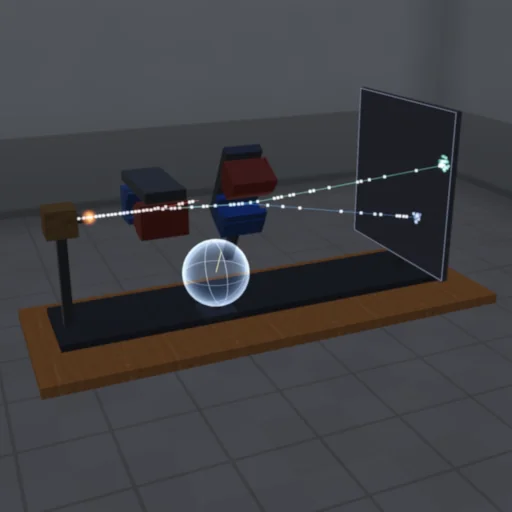
Electrons diffract off a nickel crystal: a peak at 50 degrees for 54 volts, from de Broglie's wavelength and one lattice constant. The measurement that made matter waves real.

What happens
Electrons are fired at a nickel crystal and come back as a wave: de Broglie's λ = h/√(2meV) together with one lattice constant puts the first-order maximum at 50.9° for 54 volts, and Davisson and Germer measured 50°. Nothing is tuned - turn the voltage and the peak walks exactly where d·sin φ = λ puts it, and the module finds it by scanning the curve rather than reading it off the formula that placed it. Below 32.5 V the wavelength exceeds the atom spacing, there is no first order at all, and that is reported instead of a peak jammed against the edge; the faint curve underneath is what particles bouncing off a rough surface would give - a smooth lobe with no maximum anywhere.
Equations used in the module
Equations
λ = h / p = h / √(2 m e V)   (de Broglie)
n λ = 2 d sin θ   (Bragg);   nickel d = 0.091 nm
54 V → λ = 0.167 nm → peak at 50°
the two scans (twin):  I(θ) at 54 V peaks at 50.92°, 2.057 on a classical 0.507;  I(V) at 50° peaks where the first order passes the detector, V* = h²/(2me·d²·sin²50°) = 55.45 V, half maximum 47.5…67.0 V;  threshold h²/(2me·d²) = 32.54 V