MakarovSuites
English
EnglishDeutschРусскийУкраїнськаFrançaisEspañolItalianoPolski
Contact & licences

Physics

Franck-Hertz experiment

Electrons through mercury vapour: the collector current dips every 4.9 volts, because an atom takes that energy or none at all.
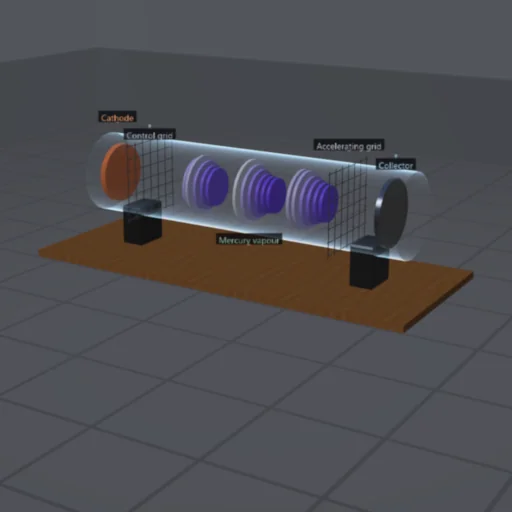
Franck-Hertz experiment — Actual application image
Actual application image

What happens

An electron gains energy along the tube and loses it in one lump the moment it can pay 4.9 eV to a mercury atom. That single rule makes the current collapse and recover as the accelerating voltage climbs. The glowing discs between the grids are where those inelastic collisions actually happened - in the real tube they are visible to the eye, and their number grows one at a time. The spacing in the readout is found by scanning the curve, not written into it.

Equations used in the module
Equations
elastic below 4.9 eV;  above it, inelastic: exactly 4.9 eV to the atom
current dips every ΔV = 4.9 V
E_Hg = 4.9 eV,   λ_emitted = 254 nm
Related experiments

Back to catalogue
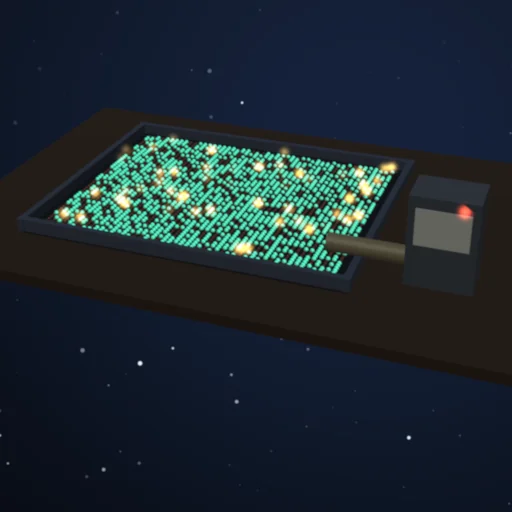
Radioactivity — Actual application image

Physics

Radioactivity

Decay as statistics: half-life from thousands of glowing nuclei, decay chains on the nuclide chart, a chain reaction going critical, and dating by isotopes.

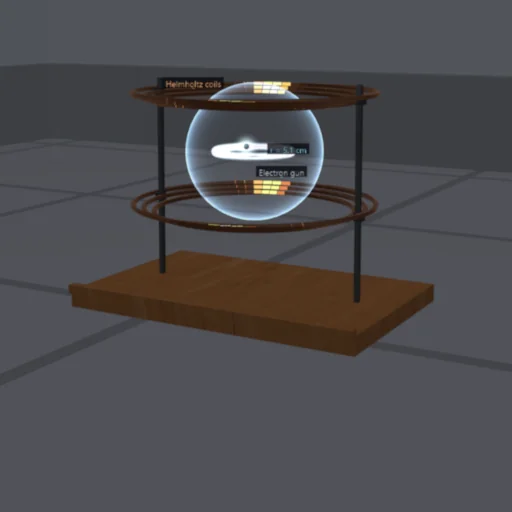
Charge-to-mass ratio — Actual application image

Physics

Charge-to-mass ratio

Accelerate electrons, bend them in Helmholtz coils, measure the circle: e/m = 2U/(B^2 r^2), with the field integrated from Biot-Savart.

Rutherford scattering — Actual application image

Physics

Rutherford scattering

The Geiger–Marsden apparatus in three dimensions: a radium source, the gold foil, a spherical screen that flashes where each alpha lands, a microscope counting one angle - and the rare bounce back that gave the atom its nucleus.