Physics
Rutherford scattering
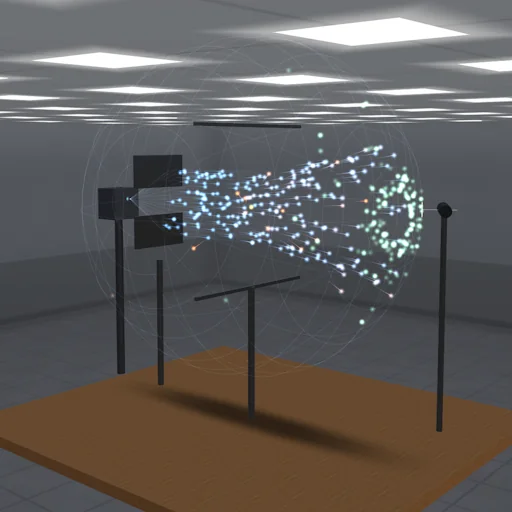
The Geiger–Marsden apparatus in three dimensions: a radium source, the gold foil, a spherical screen that flashes where each alpha lands, a microscope counting one angle - and the rare bounce back that gave the atom its nucleus.
What happens
Fire alpha particles at gold and watch the trails bend into hyperbolas - cool while they fly straight, igniting as they turn. Almost all slip through almost untouched; once in a while one meets the nucleus nearly head-on and comes straight back, and the histogram grows the famous 1/sin4 tail right onto its overlay. Then press Thomson: spread the same charge over the whole atom, and the backscatter vanishes - exactly the observation that gave the atom its nucleus.
Equations used in the module
Equations
b = (Z₁ Z₂ e² / (4πε₀ E)) cot(θ/2)   (impact parameter)
dσ/dΩ = (Z₁ Z₂ e² / (16πε₀ E))² / sin⁴(θ/2)
closest approach at θ = 180°:  r = Z₁ Z₂ e² / (4πε₀ E)