MakarovSuites
English
EnglishDeutschРусскийУкраїнськаFrançaisEspañolItalianoPolski
Contact & licences

Physics

Charge-to-mass ratio

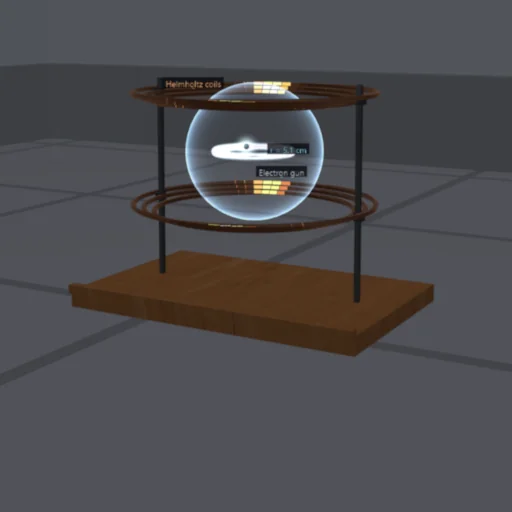
Accelerate electrons, bend them in Helmholtz coils, measure the circle: e/m = 2U/(B^2 r^2), with the field integrated from Biot-Savart.
Charge-to-mass ratio — Actual application image
Actual application image

What happens

Two things are computed rather than assumed. The field is integrated from Biot-Savart over both coils, so the uniformity of a Helmholtz pair is a result - it matches the closed form at the centre to a tenth of a percent and stops matching a few centimetres out. The orbit is pushed with a Boris scheme, which keeps the speed exact, and e/m is then read back from the radius the trace actually reached.

Equations used in the module
Equations
e V = ½ m v²,   e v B = m v² / r
e/m = 2 V / (B² r²)
B from Biot–Savart, integrated over the coils
Related experiments

Back to catalogue
Rutherford scattering — Actual application image

Physics

Rutherford scattering

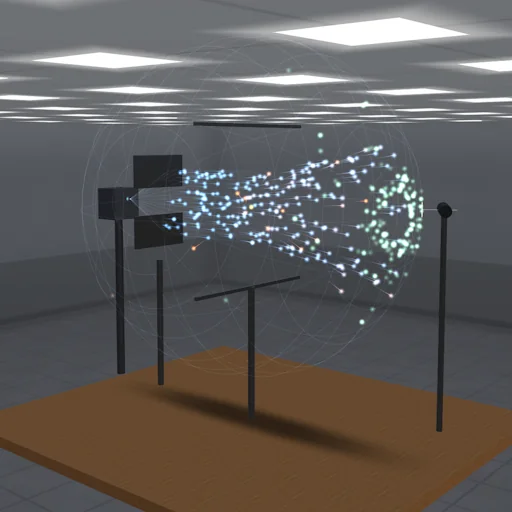
The Geiger–Marsden apparatus in three dimensions: a radium source, the gold foil, a spherical screen that flashes where each alpha lands, a microscope counting one angle - and the rare bounce back that gave the atom its nucleus.

Nuclear power plant — Actual application image

Physics

Nuclear power plant

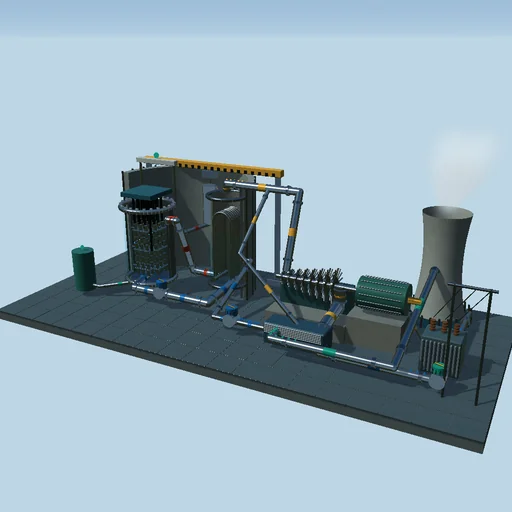
Follow energy from a controlled chain reaction through three water circuits to the electrical grid. Explore xenon, shutdown and cooling failures.

Compton scattering — Actual application image

Physics

Compton scattering

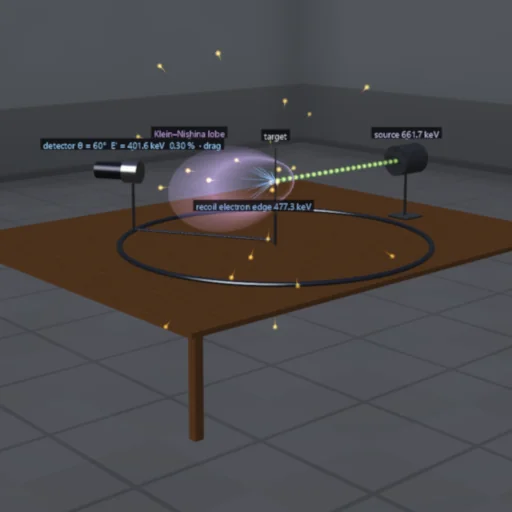
A photon hits a free electron and comes off with less energy and a longer wavelength. The shift depends on the angle and not on the energy.