Physics
Spin and measurement
Stern-Gerlach for real: atoms split in a field gradient, sequential analyzers obey the cos²(θ/2) law, and measurement collapses the state on the Bloch sphere.
What happens
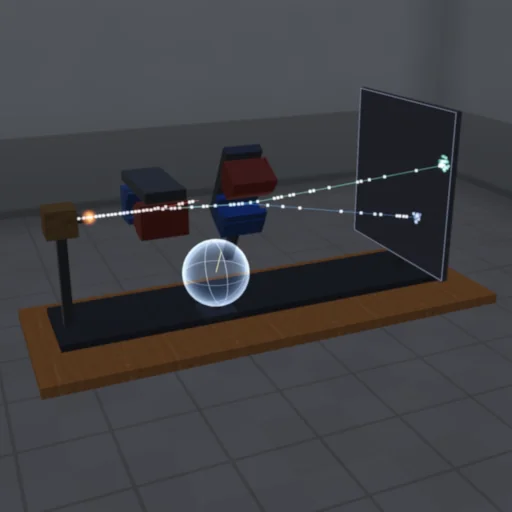
Silver atoms fly from the oven through up to three rotatable Stern-Gerlach magnets and land as the iconic two spots - split by the honest 3.6 mm the field gradient earns. Chain the analyzers and the quantum rules play out live: a repeated axis reproduces its answer with certainty, a tilted one obeys cos²(θ/2), an x-analyzer wedged between two z-analyzers erases the memory back to 50/50, and the 0°/90°/180° cascade lets an eighth through where removing its middle stage blocks everything. The Bloch sphere shows the state collapsing at every magnet, and the frequency chart hunts its target at the 1/√N clip.
Equations used in the module
Equations
P(+ along b | + along a) = cos²(θ/2)
F_z = μ_z dB/dz   (Stern–Gerlach: two beams, never a smear)
measurement collapses the state to the analyzer's axis