Physics
Method of mixtures
Hot metal into cold water: from the final temperature alone, the specific heat of the metal - if the calorimeter is counted too.
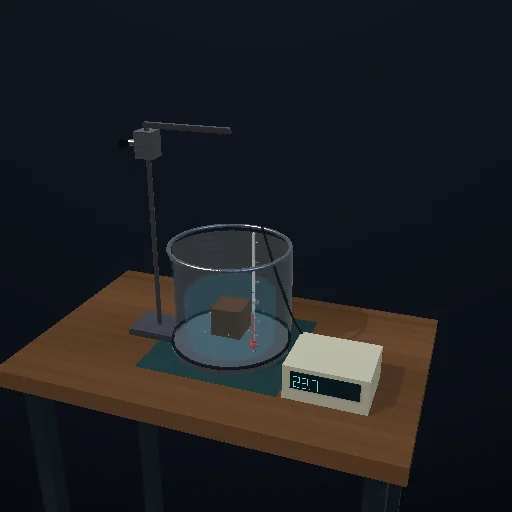
What happens
Nothing here jumps to the equilibrium temperature. The two bodies exchange heat at a rate set by their difference, the vessel carries its own heat capacity, and the specific heat is computed backwards from where the run actually landed - which is what a student does with a thermometer. Turn the leak on and the measurement comes out systematically low, because heat that left the room is booked as heat the metal never had.
Equations used in the module
Equations
m_m c_m (T_m − T_f) = (m_w c_w + C_cal)(T_f − T_w)
c_m = (m_w c_w + C_cal)(T_f − T_w) / (m_m (T_m − T_f))
leave C_cal out and c_m comes out too small
ice into water:  c_w m_w (T_w − T_f) + C_cal (T_w − T_f) = m_i c_i (0 − T_i) + m_i L + m_i c_w (T_f − 0),  c_i = 2090, L = 334 kJ/kg;  300 g at 20 °C + 50 g ice at −10 °C (C_cal 60 J/K): T_f = 5.61 °C, the run settles at 5.608 (twin)