Physics
Molecules and light
Why CO₂ absorbs infrared and N₂ does not: molecules as masses and springs, true normal modes, and resonance when the photon matches the mode.
What happens
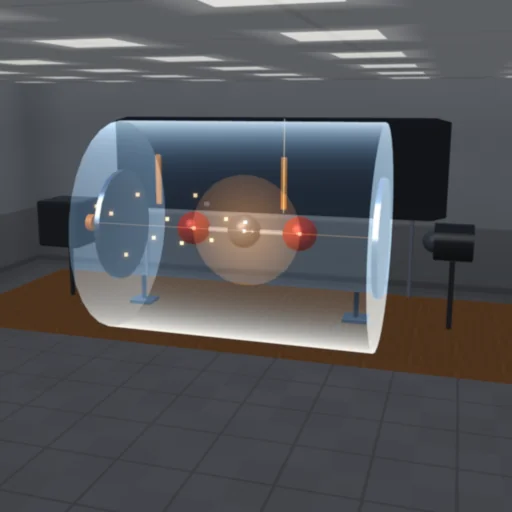
Every molecule here is masses on springs, and its vibrations are true normal modes - a finite-difference Hessian diagonalized on the spot, calibrated to the real tables: CO₂ rings at 667, 1333 and 2349 1/cm. Tune the photon stream onto an IR-active line and the light vanishes into that very motion, the molecule glowing as the mode drinks energy. Tune onto the symmetric stretch of CO₂ - the right frequency, but the dipole never moves - and the photons sail through untouched. N₂ and O₂ carry no charges at all: nothing they do can catch infrared, which is exactly why the air’s main gases are not greenhouse gases while its traces run the climate.
Equations used in the module
Equations
M ü = −K u   →   normal modes ω_k
absorbed only if a mode changes the dipole moment
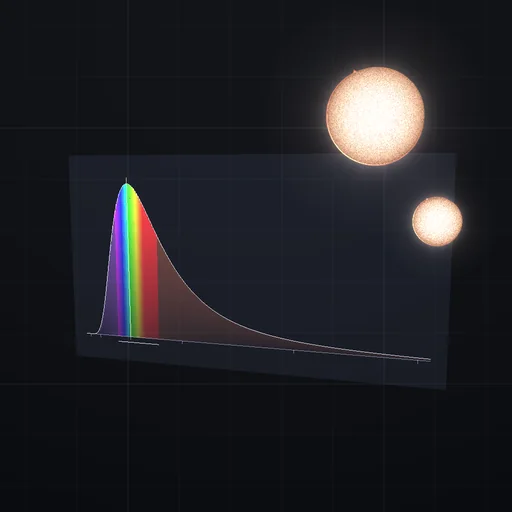
CO₂ bends at 667 per cm, near Earth's 288 K peak;  N₂, O₂: none