Physics
Semiconductors
The p-n junction from the inside: doping, band bending, the depletion zone and the diode's I-V curve from an honest drift-diffusion solver.
What happens
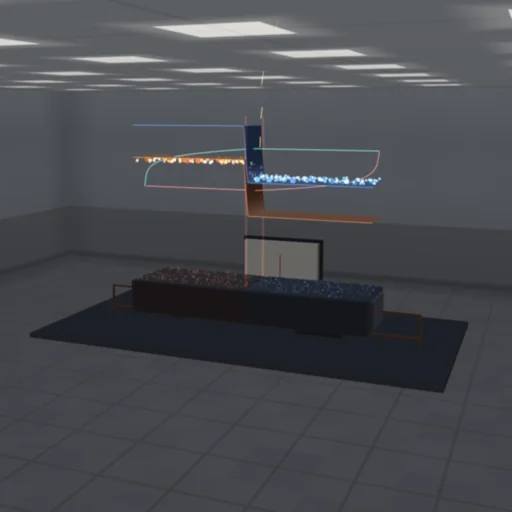
A stationary Scharfetter–Gummel drift-diffusion solve supplies the potential, carrier densities and current. The 3D ribbons show energy bands; moving markers explain transport and recombination. They are not microscopic trajectories or quantitative emission rates. Material and temperature set the physical unit scales. For an ideal diode, a tenfold current increase requires ln(10)·kT/q of extra forward voltage, about 59.5 mV at 300 K.
Equations used in the module
Equations
J_n = q n μ_n E + q D_n dn/dx,   J_p = q p μ_p E − q D_p dp/dx
d²φ/dx² = −q (p − n + N_D − N_A) / ε
I = I_s (exp(qV / kT) − 1)   (diode)
real units:  n_i = √(N_c N_v)(T/300)^1.5 exp(−E_g/2kT) - Si 6.7e9, Ge 2.3e13, GaAs 2.1e6 1/cm³ at 300 K;  L_D = √(εkT/q²n_i) - Si 50 µm, Ge 1.0 µm, GaAs 2.9 mm;  J_unit = qD_n n_i/L_D - Si 7.7e-6, Ge 3.6, GaAs 2.6e-10 A/cm²;  I = J·J_unit·1 mm²