Physics
Bending waves in a bar
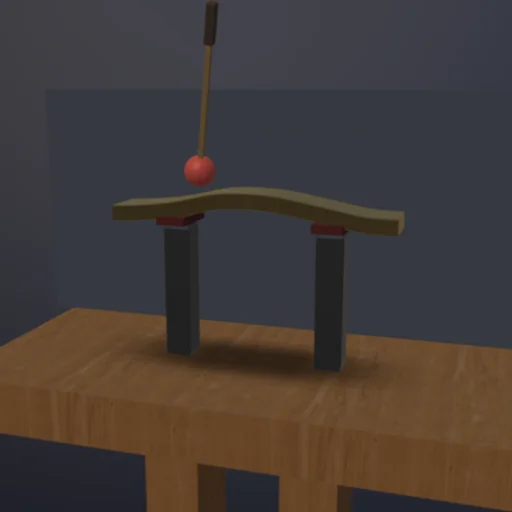
A struck free-free bar: bending waves are dispersive - the overtones are not integer multiples of the fundamental, unlike a string.
What happens
A taut string's overtones are exact integer multiples of the fundamental - that is WHY plucked strings sound musical. A stiff bar, ringing from its own bending stiffness rather than tension, breaks that rule completely: its overtones sit at roughly 2.76, 5.40, 8.93 times the fundamental, nowhere near 2, 3, 4. That mismatch is dispersion, and it is why a struck metal rod or a tuning fork has that unmistakable "clang" rather than a musical tone - the overtones simply do not line up into a harmonic series. Strike the bar anywhere along its length and watch it ring; nothing here is stepped forward through time one frame at a time, so the vibration's total energy never drifts, no matter how long it rings. The bar is shown in its own centre-of-mass frame, so it does not drift or tumble across the screen; a real free bar, struck off-centre, would do both.
Equations used in the module
Equations
EI ∂⁴y/∂x⁴ + ρA ∂²y/∂t² = 0
ω_n = (β_n L)² √(EI/ρA) / L²,   β_n L = 4.730, 7.853, 10.996…
f₂/f₁ = 2.76, f₃/f₁ = 5.40   (not integers: dispersion)