Astronomy
Artificial gravity in orbit
Explore a rotating observatory in two simultaneous reference frames. Release objects, throw a ball, collide cargo and swing a pendulum. Keep the telescope pointed at a distant star.
What happens
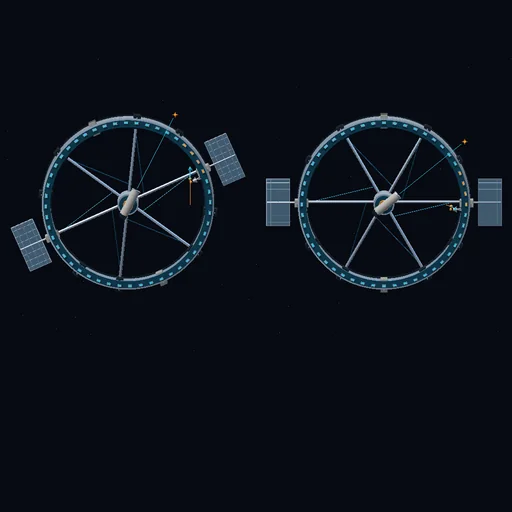
One station, two reference frames. Compare free flight, contact with the rotating floor and telescope tracking.
Try this
Both views show the same experiment. The station rotates on the left and stays fixed on the right. Changing physical parameters starts a new experiment.
The model and its limits
Planar rigid-body mechanics in local free fall. The station has a prescribed speed and can supply energy through contact. The telescope uses ideal pointing control. Objects are enlarged; trusses and telescope occupy a separate deck. Gravity gradients, structural flex and orbital motion are omitted.
Equations used in the module
Equations
θ = Ωt; g = Ω²R
r_station = Rot(-θ) r
v_station = Rot(-θ) (v - Ω × r)
a_station = Rot(-θ) a - 2Ω × v_station - Ω × (Ω × r_station)