Astronomy
Stellar evolution tracks
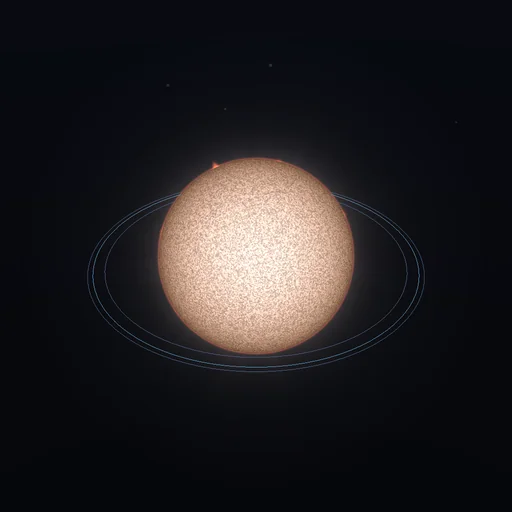
A star and its Hertzsprung-Russell diagram on the same clock. The colour comes from the track temperature through the Planck curve, the size from the radius that follows from L and T - nothing is hand-coloured.
What happens
A star and its Hertzsprung-Russell diagram on the same clock. The colour comes from the track temperature through the Planck curve, the size from the radius that follows from L and T - nothing is hand-coloured. A teaching model: mass–luminosity and mass–radius laws, solar calibration T☉ = 5772 K, and schematic later phases. Radii follow L and T. Composition, rotation, mass loss and binary evolution are not solved; remnant thresholds are approximate.
Equations used in the module
Equations
Solar units: L(M) = 0.23 M^2.3 for M<0.43; M^4 for M<2; 1.4 M^3.5 for M<55; 32000 M above.
R(M) = M^0.8 below one solar mass; M^0.57 above.
T = T_sun (L/R^2)^(1/4), with the adopted solar calibration T_sun = 5772 K.
t_MS = 10 Gyr M/L: log t versus log M has slope 1 minus the local luminosity exponent.
Later phases: schematic named anchors in log T and log L; radius R = sqrt(L)/(T/T_sun)^2.
Representative remnant radii: white dwarf about 0.0152 R_sun; neutron star about 12 km.
Approximate teaching thresholds: white dwarf below 8 M_sun, neutron star below 25, black hole above.
No metallicity grid, stellar-structure integration, binary interaction or mass-loss calculation.