Physics / Astronomy
Telescope optics
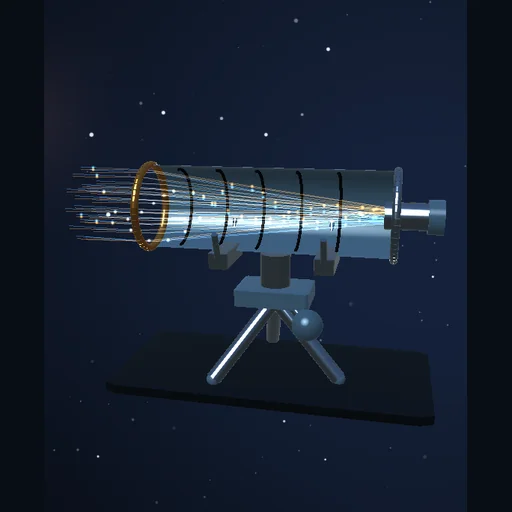
Explore a telescope in 3D, diffraction rings and a surface of light intensity. Compare aperture, wave defocus and atmosphere on one angular scale.
What happens
Explore a telescope in 3D, diffraction rings and a surface of light intensity. Compare aperture, wave defocus and atmosphere on one angular scale.
Monochromatic scalar paraxial optics. Defocus is a quadratic pupil phase; seeing is a Gaussian long-exposure blur. No speckles, coma, colour aberration, sensor noise or spiders in diffraction. A and B share an angular field but each uses its own peak for display. The eyepiece reports magnification, not added detail. Rayleigh is a clear-pupil equal-star reference, not a universal threshold. Rays and direction markers are schematic; they do not calculate the wave image. Colour maps intensity, not wavelength.
The model and its limits
Monochromatic scalar paraxial optics. Defocus is a quadratic pupil phase; seeing is a Gaussian long-exposure blur. No speckles, coma, colour aberration, sensor noise or spiders in diffraction. A and B share an angular field but each uses its own peak for display. The eyepiece reports magnification, not added detail. Rayleigh is a clear-pupil equal-star reference, not a universal threshold. Rays and direction markers are schematic; they do not calculate the wave image. Colour maps intensity, not wavelength.
Equations used in the module
Equations
x=pi D theta/lambda; A(x)=2/(1-epsilon^2) integral_epsilon^1 rho J0(x rho) exp(i 2pi w rho^2) d rho
I=|A|^2; w~Delta D^2/(8 lambda f^2); seeing: Gaussian FWHM
Rayleigh(clear pupil)=1.21967 lambda/D; flux proportional to D^2(1-epsilon^2)
M=f/f_eye; PSF unaffected by eyepiece; two incoherent stars: sum of intensities
Sensor cells integrate intensity; A/B field shared; linear profile normalized to each image peak.