Physics
Charges in fields
A swarm of charged particles: traps, drifts, focusing.
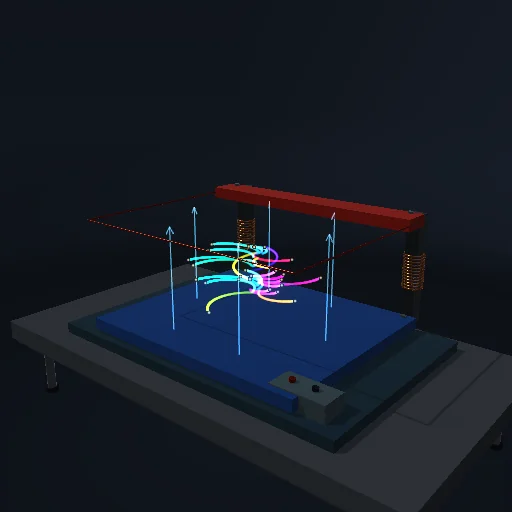
What happens
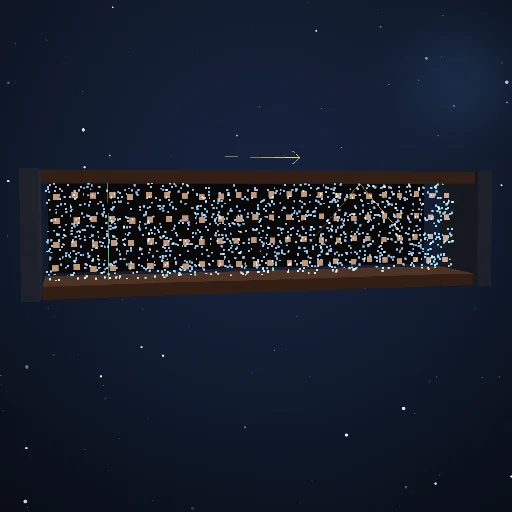
A swarm of charged particles injected as ONE compact bunch into electric and magnetic fields. In a pure magnetic field the cyclotron period does not depend on speed, so the bunch spreads into a rainbow ring and refocuses back into a point every single period - isochronism you can watch. Crossed fields march the whole bunch sideways along the green drift arrow; the magnetic bottle pinches its own field lines at the ends and bounces the particles between the mirrors, while the loss cone escapes. Colour is the gyration phase; the chart tracks the mean drift. The fields are made by things: pole pieces N and S on an iron yoke for B, capacitor plates for E, two copper coils for the bottle. The velocity selector crosses E and B over a continuous beam of mixed speeds - only v = E/B flies straight through the slit at the exit; the faster bend one way, the slower the other, and the wall takes them.
Equations used in the module
Equations
F = q (E + v × B)
r = m v / (q B),   ω = q B / m
E × B drift:  v_d = E / B