Physics
Inside the wire
Electric current up close: an electron gas drifts through a vibrating lattice - drift vs thermal speed, Joule heating, and why resistance grows with temperature.
What happens
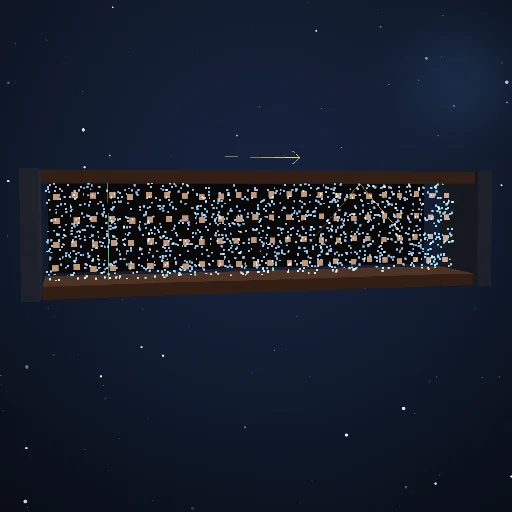
Two thousand electrons rattle between the lattice ions at thermal speed, and only the marked one with its glowing trail betrays the truth: the field adds a drift ten times smaller than the jitter, exactly eEτ/m, and the slow green front line makes that crawl visible. Turn up the field and watch the Joule power flow into the lattice - the ions shake harder, the metal glows, and the conductivity trace sags, because a hotter lattice scatters more: resistance grows with temperature. Then switch benches and fire a pulse: the voltage front races down the LC ladder at 1/√(LC) while the electrons underneath barely move - the signal flies, the electrons crawl.
Equations used in the module
Equations
m dv/dt = −e E − m v / τ   →   v_d = −e E τ / m
σ = n e² τ / m,   ρ = 1/σ
P = I² R   (Joule heat),   v_d is far below v_thermal