Physics
Casimir effect
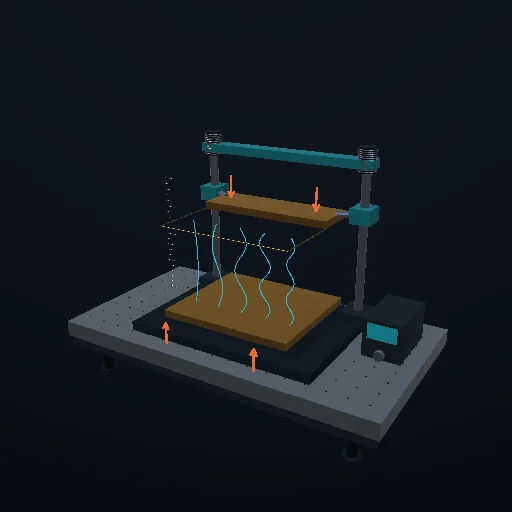
Two plates in vacuum attract because the modes that fit between them are fewer than the ones outside. The difference of two infinities is computed here, not quoted: watch the divergent sum leave −1/12 behind.
What happens
Two plates in vacuum attract because only whole half-waves fit between them, while outside every mode fits. Both sums are infinite, and the difference is computed here rather than quoted: damp the sum, watch the 1/ε² piece cancel because it does not depend on the gap, and see −0.083333 left behind - ζ(−1) = −1/12 appearing instead of being asserted. The gap slider is logarithmic because the force spans eleven decades: halve the separation and the pressure rises sixteenfold, and at ten nanometres the vacuum presses harder than the atmosphere does.
Equations used in the module
Equations
P = −π² ħ c / (240 d⁴)
F = P · A,   E = −π² ħ c A / (720 d³)
temperature:  P(d,T) = −(2kT/π) Σ'_l I(ξ_l/c),  ξ_l = 2πl kT/ħ (l = 0 at half weight),  I(k₀) = ∫_{k₀}^∞ κ²/(e^{2κd} − 1) dκ = k₀²/2d·(−ln(1 − e^{−a})) + 2k₀/(2d)²·Li₂(e^{−a}) + 2/(2d)³·Li₃(e^{−a}),  a = 2k₀d
limits:  T → 0: −π²ħc/240d⁴;  T → ∞: −ζ(3)kT/(4πd³);  thermal length ħc/kT = 7.63 µm at 300 K
measured (twin), 300 K:  P/P₀ = 1.00157 at 1 µm, 1.117 at 3 µm, 2.327 at 7.63 µm, 6.095 at 20 µm;  P/P_classical = 1.000000 at 20 µm