Physics
Gauss's law
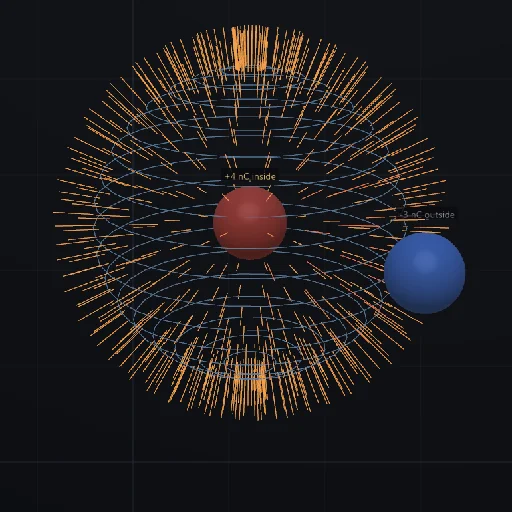
Integrate E.dA over a closed surface and compare with Q/e0. Move a charge out and the total jumps; move it about inside and nothing changes.
What happens
The flux is integrated numerically over thousands of patches, and nothing in that integration knows which charges are inside. That is what makes the comparison worth anything: slide a charge through the wall and the total jumps by exactly q/e0, while every patch it was evaluated on changed smoothly. Push the surface onto a charge and the quadrature breaks down - the panel says so, because that is a fact about the method, not about the law.
Equations used in the module
Equations
∫ E·dA = Q_enclosed / ε₀   (over a closed surface)
E = Q / (4πε₀ r²)   outside a sphere,   E = 0 inside a shell
E = σ / (2ε₀)   (sheet),   E = λ / (2πε₀ r)   (line)
the split:  ∫E·dA = Φ_out + Φ_in;  the law fixes the sum, not the parts:  sphere r = 0.70 about +4 and −3 nC: 238.4 out, −125.4 in, net 112.97 = 1 nC/ε₀
the staircase:  Φ(r) = Q_enclosed(r)/ε₀ - a step of q/ε₀ at every charge crossed;  the quadrature spikes when the wall sits on a charge (r = 0.569: 205 against 113)
nested:  the same shape at 1.4 ×: same charges, same flux (451.80 → 451.80), twice the area