Physics
Electron optics
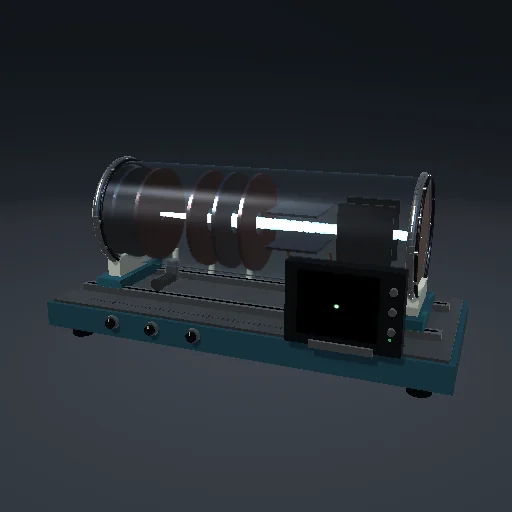
An electron gun, a lens and two deflection pairs in 3D: the beam is steered by a solved field.
What happens
A vacuum tube in 3D, slowed about ten million times. The electrode voltages set the boundaries, the axisymmetric Laplace equation is solved between them, and the electrons fly through the field that comes out, so nothing about the focusing is scripted. Moving a slider recombines the solution instantly and the beam answers in real time. Two deflection pairs steer the spot in both directions: try the sweep, the Lissajous figure and the kinescope raster, and watch the picture build up on the phosphor - the close-up in the corner is the screen itself. Drag with the right mouse button to orbit.
Equations used in the module
Equations
½ m v² = e V   (gun)
1/f ∝ ∫ E_z′² dz / V   (electrostatic lens)
y = (e V_d / (2 m v²)) · L² / d   (deflection)