Astronomy
Comet tails
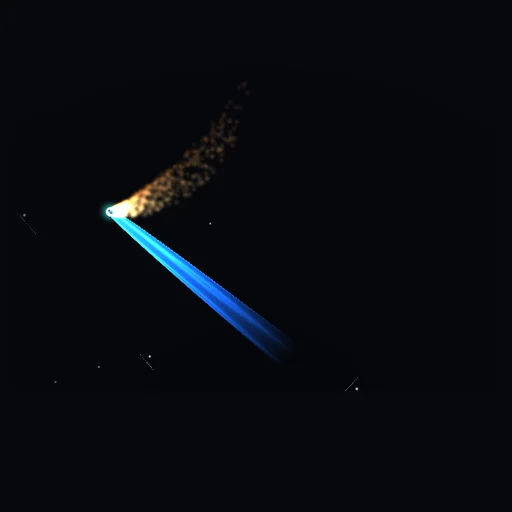
Explore two comet tails: select dust size and age, compare radiation pressure and solar wind, and rotate the three-dimensional cloud.
What happens
Explore two comet tails: select dust size and age, compare radiation pressure and solar wind, and rotate the three-dimensional cloud.
Solar test-particle model: constant Qpr, prescribed isotropic ejection, uniform sampling in age and log size. No sublimation rate, grain collisions, planets, nucleus gravity or changing charge. Ion axis = radial solar wind minus comet velocity; steady local kinematic illustration, not MHD. Tail width, filaments, coma, nucleus and brightness are illustrative. Dust is not deleted at beta=1; escape depends on release energy. A scene click selects the sampled grain and its launch direction. Parameter controls retain that direction; presets reset it to the orbital normal. Apparent sunward projections can occur; neither tail is defined as opposite velocity.
The model and its limits
Solar test-particle model: constant Qpr, prescribed isotropic ejection, uniform sampling in age and log size. No sublimation rate, grain collisions, planets, nucleus gravity or changing charge. Ion axis = radial solar wind minus comet velocity; steady local kinematic illustration, not MHD. Tail width, filaments, coma, nucleus and brightness are illustrative. Dust is not deleted at beta=1; escape depends on release energy. A scene click selects the sampled grain and its launch direction. Parameter controls retain that direction; presets reset it to the orbital normal. Apparent sunward projections can occur; neither tail is defined as opposite velocity.
Equations used in the module
Equations
dust: d²r/dt² = −GM(1 − beta) r/|r|³; beta = 0.57 Qpr/(rho s), rho [g/cm³], s [micrometres]
beta = 1: zero central force, straight motion; beta > 1: repulsive net central force, particles remain in the calculation
zero ejection: energy = GM(beta/r_release − 1/(2a)); escape at beta >= r_release/(2a), NOT generally at beta = 1
ion axis: u_rel = v_wind r_hat − v_comet; tan psi = v_transverse/(v_wind − v_radial)
dust: adaptive step-doubled RK4 in 3D; steady Qpr, no drag, charge, collisions or planets
synchrone: same release epoch, different beta; syndyne: same beta, different release epochs; guide curves use zero ejection
equal age/log-size sampling, colour and brightness are NOT a dust-production or radiative-transfer calculation