Astronomy
Accretion disk
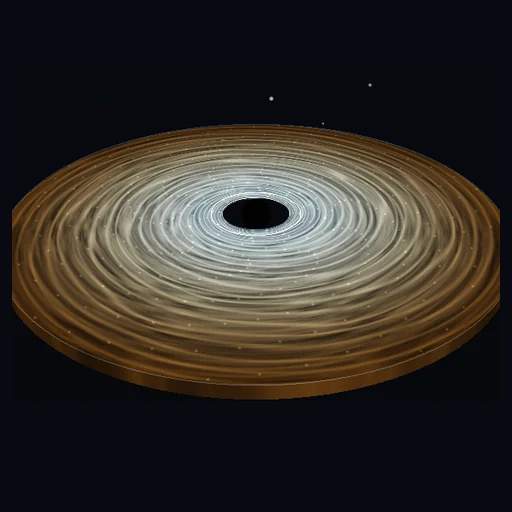
Explore a luminous 3D accretion disc: select an annulus, isolate its spectrum and compare inward mass flow with outward angular-momentum transport.
What happens
A steady Newtonian zero-inner-torque disc, not a GRMHD simulation. H/r is prescribed independently: effective surface temperature does not determine the midplane temperature. The same finite radiating radius is used for scene, luminosity and spectrum; an outer reservoir supplies mass and accepts torque. Optical thickness, local thermal radiation and a constant alpha are assumed. No vertical thermal solution, radiation pressure, winds, corona, absorption, scattering hardening, relativistic Doppler shift, gravitational redshift or light bending. The 6 GM/c² edge is only a Schwarzschild reference in a Newtonian formula. The white-dwarf radius is specified, not inferred from mass; boundary-layer and stellar light are omitted from the spectrum. Eddington is a spherical ionized-hydrogen reference, not an automatic wind threshold. The texture and exposure are illustrative; visible CIE colours are normalized and brightness is compressed. Log radius and amplified thickness are display transforms. The orbital and inward-journey clocks are separate.
Equations used in the module
Equations
F(r) = 3GM Mdot / (8πr³) [1 − sqrt(r_in/r)]; T_eff = (F/σ)^(1/4)
r(T_max) = (49/36) r_in; T_eff(r_in) = 0
L(<R) = GM Mdot/(2r_in) [1 − 3r_in/R + 2(r_in/R)^(3/2)]
L_ν = 4π² integral r B_ν(T_eff) dr; F_ν(obs) = L_ν cos(i)/(2πD²)
ν_visc = α(H/r)² r² Ω; Σ = Mdot[1−sqrt(r_in/r)]/(3πν_visc)
v_r = −Mdot/(2πrΣ); Mdot sqrt(GMr) − torque = Mdot sqrt(GMr_in)
L_Edd = 4πGM m_p c/σ_T