MakarovSuites
English
EnglishDeutschРусскийУкраїнськаFrançaisEspañolItalianoPolski
Contact & licences

Astronomy

Two burns to a new orbit

Raise an Earth orbit, or fly the same two burns to the Moon, Venus, Mars or Jupiter: the phasing, the launch window, the burn from the parking orbit and the capture at the other end, and the bi-elliptic alternative.
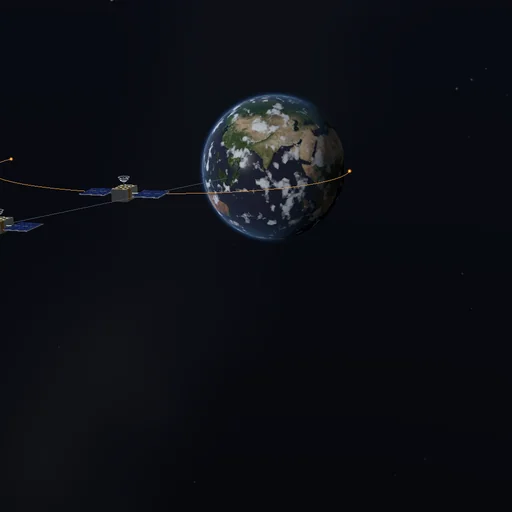
Two burns to a new orbit — Actual application image
Actual application image

The model and its limits

Two impulsive tangential burns between coplanar circular orbits about one centre (the Earth, or the Sun with the catalogue's semi-major axes as circles). Departure and capture are patched conics with v∞ from the heliocentric impulse; windows from mean longitudes, not from a pork-chop search. No finite burns, drag, plane changes or eccentric planet orbits.

Equations used in the module
Equations
a_t = (r₁+r₂)/2; Δv₁ = √(μ/r₁)[√(2r₂/(r₁+r₂))-1]; t_t = π√(a_t³/μ)
Δv_park = √(v∞² + 2μ_E/r_p) − √(μ_E/r_p); Δv_capture = √(v∞² + 2μ_t/r_c) − √(μ_t/r_c); T_syn = 1/|1/T₁ − 1/T₂|
Related experiments

Back to catalogue
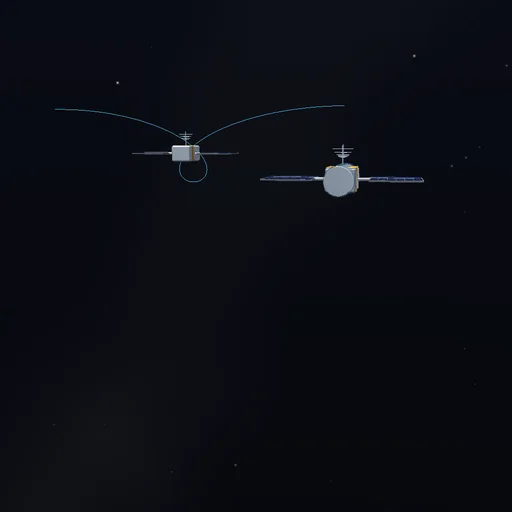
Rendezvous in a moving frame — Actual application image

Astronomy

Rendezvous in a moving frame

Give a nearby spacecraft a radial offset and an along-track impulse. Watch the curved relative path and find a closed formation orbit.

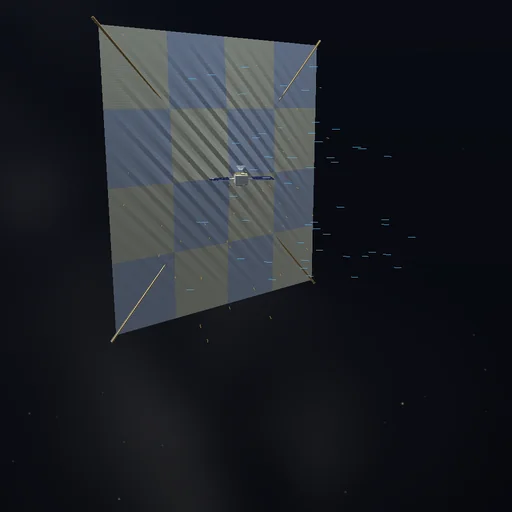
Sailing on sunlight — Actual application image

Astronomy

Sailing on sunlight

Tilt a reflecting sail. Resolve photon pressure into radial and tangential thrust and find the angle that gives the strongest sideways push.

Jupiter’s resonance clock — Actual application image

Astronomy

Jupiter’s resonance clock

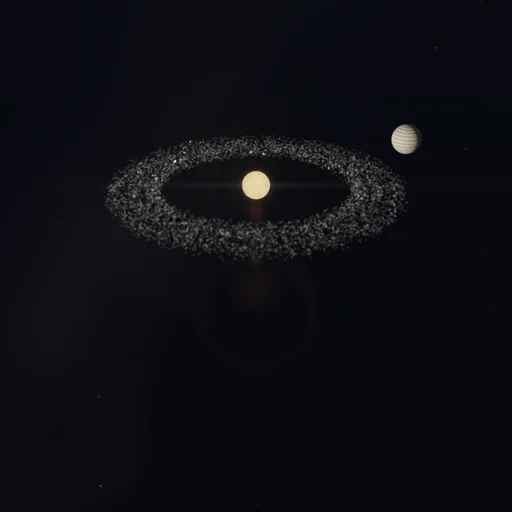
Thousands of asteroids integrated under an eccentric Jupiter: the resonances pump their eccentricities until the orbits cross Mars or Jupiter, and the gaps open by themselves. Make Jupiter heavier to watch it happen within the run.