MakarovSuites
English
EnglishDeutschРусскийУкраїнськаFrançaisEspañolItalianoPolski
Contact & licences

Astronomy

Jupiter’s resonance clock

Thousands of asteroids integrated under an eccentric Jupiter: the resonances pump their eccentricities until the orbits cross Mars or Jupiter, and the gaps open by themselves. Make Jupiter heavier to watch it happen within the run.
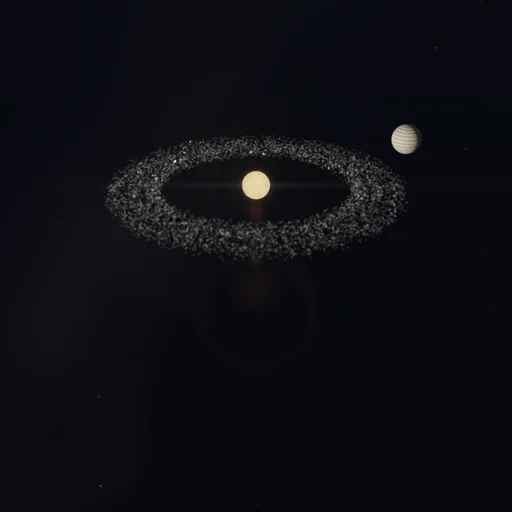
Jupiter’s resonance clock — Actual application image
Actual application image

The model and its limits

The planar elliptic restricted problem: the Sun and Jupiter only, Jupiter on a fixed ellipse, no Saturn, no secular resonances, no Mars or Earth beyond the removal rule. The accelerator is Jupiter’s mass; the real clearing took millions of years. The P:Q ring is the Keplerian locator of ring 2.

Equations used in the module
Equations
a_res = a_J(q/p)^(2/3); T ∝ a^(3/2); T_syn = 1/|1/T - 1/T_J|
integrated: a = −GM r/r³ − Gm (r − r_J)/|r − r_J|³ − Gm r_J/r_J³; removed when q < 1.52 AU or Q > 0.94 a_J
Related experiments

Back to catalogue
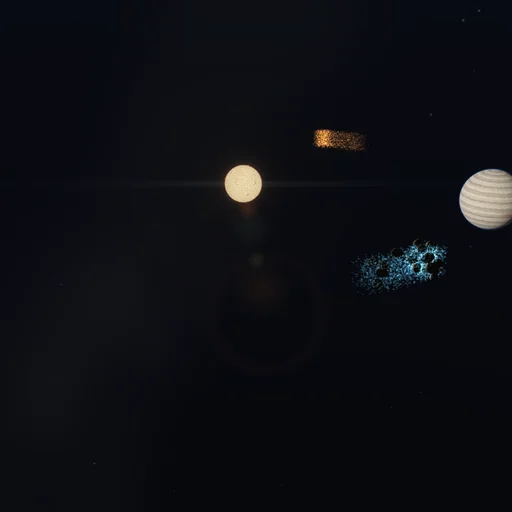
Trojan swarms — Actual application image

Astronomy

Trojan swarms

Swarms integrated about the triangular points in the rotating frame: tadpoles at small amplitude, horseshoes past the critical one, dispersal once the planet exceeds Routh’s limit.

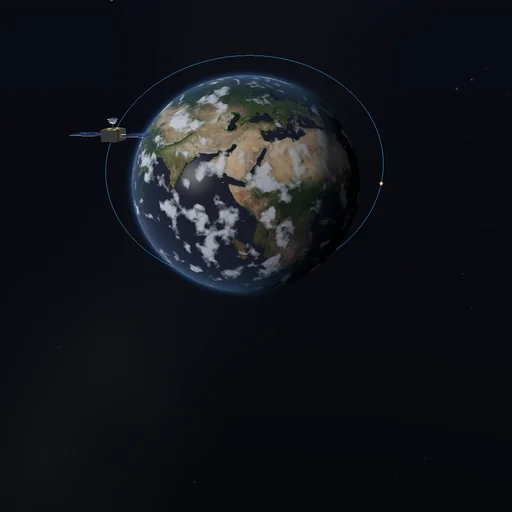
An orbit that turns — Actual application image

Astronomy

An orbit that turns

Tilt an Earth orbit. Watch its orbital plane precess and compare the node drift with the special polar case.

Mercury’s three-to-two rhythm — Actual application image

Astronomy

Mercury’s three-to-two rhythm

Track a surface meridian over two eccentric orbits. Change the spin ratio and see why Mercury presents alternating faces at successive perihelia.