MakarovSuites
English
EnglishDeutschРусскийУкраїнськаFrançaisEspañolItalianoPolski
Contact & licences

Astronomy

Trojan swarms

Swarms integrated about the triangular points in the rotating frame: tadpoles at small amplitude, horseshoes past the critical one, dispersal once the planet exceeds Routh’s limit.
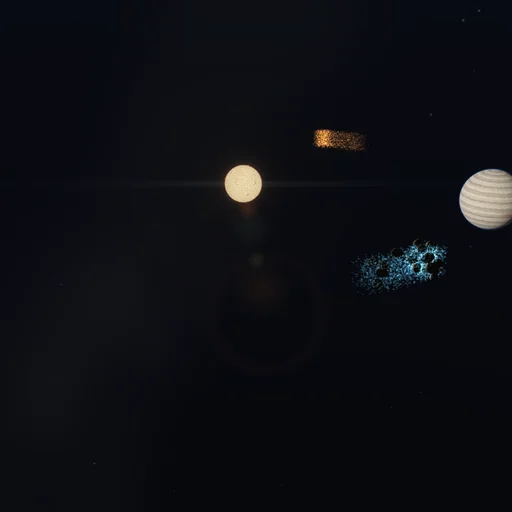
Trojan swarms — Actual application image
Actual application image

The model and its limits

The planar circular restricted problem: the planet on a circle, no Saturn, no inclination, no eccentricity of the planet. The linear readings (period, frequency, growth) are ring 2’s formulas; the integrated swarms are the Tier A run.

Equations used in the module
Equations
ν/n = √((1 − √(1 − 27μ(1−μ)))/2); φ = ±π/3 + A cos(νt); stability: 27μ(1-μ) < 1
integrated: a = −(1−μ) r/r³ − μ (r − r_J)/|r − r_J|³ − μ r_J; C_J = x² + y² + 2(1−μ)/r₁ + 2μ/r₂ − v²
Related experiments

Back to catalogue
An orbit that turns — Actual application image

Astronomy

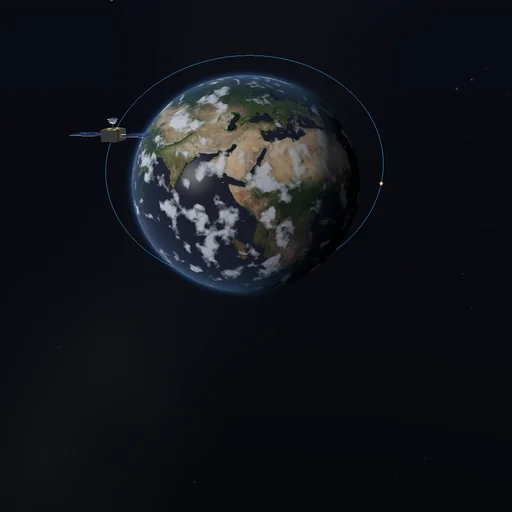
An orbit that turns

Tilt an Earth orbit. Watch its orbital plane precess and compare the node drift with the special polar case.

Mercury’s three-to-two rhythm — Actual application image

Astronomy

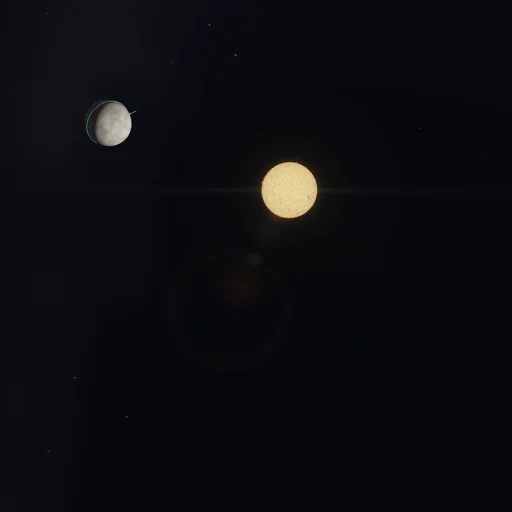
Mercury’s three-to-two rhythm

Track a surface meridian over two eccentric orbits. Change the spin ratio and see why Mercury presents alternating faces at successive perihelia.

Braking against an atmosphere — Actual application image

Astronomy

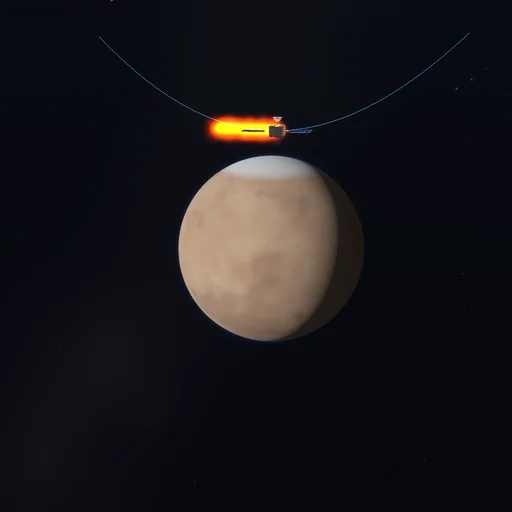
Braking against an atmosphere

Lower a spacecraft’s periapsis into a thin atmosphere. Compare drag energy loss and peak heating along an idealized grazing pass.