MakarovSuites
English
EnglishDeutschРусскийУкраїнськаFrançaisEspañolItalianoPolski
Contact & licences

Astronomy / Earth

Where a satellite flies overhead

Pick a real satellite or build your own: altitude, inclination, eccentricity and perigee. Follow its path over the rotating Earth and on the flat map, and find the orbits that repeat, hang over the north, or keep pace with the Sun.
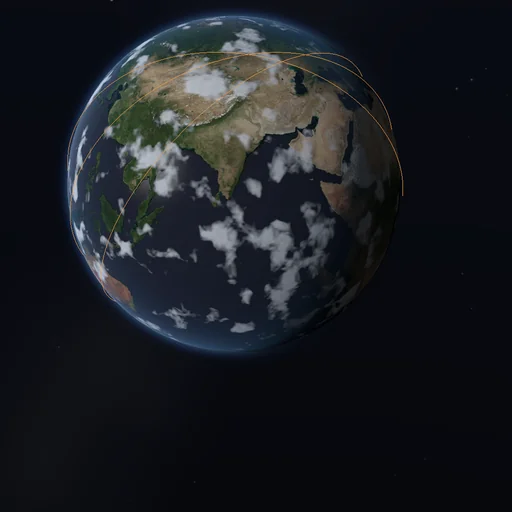
Where a satellite flies overhead — Actual application image
Actual application image

The model and its limits

A spherical rotating Earth with the secular J2 rates of node and perigee (the perigee's only on an eccentric orbit); Kepler's equation for the position; no drag, no higher harmonics, no station keeping, no mean-motion correction. The map is equirectangular; the globe texture puts longitude 0 on +x.

Equations used in the module
Equations
T = 2π√(a³/μ); r_ECEF = Rz(-Ω_E t) r_ECI
dΩ/dt = −3/2 J2 n (R/p)² cos i; dω/dt = 3/4 J2 n (R/p)² (5cos²i − 1); p = a(1 − e²); E − e sin E = M
Related experiments

Back to catalogue
Two burns to a new orbit — Actual application image

Astronomy

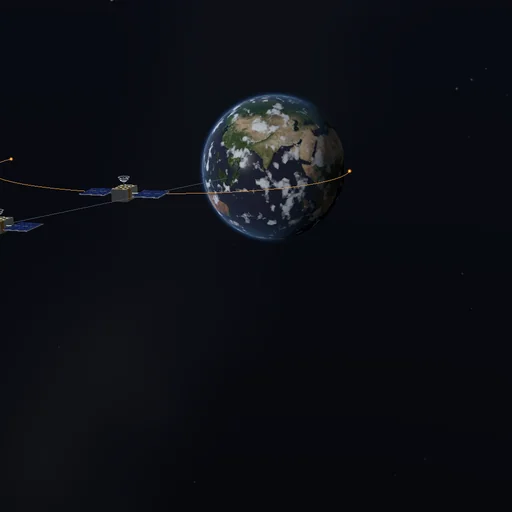
Two burns to a new orbit

Raise an Earth orbit, or fly the same two burns to the Moon, Venus, Mars or Jupiter: the phasing, the launch window, the burn from the parking orbit and the capture at the other end, and the bi-elliptic alternative.

Rendezvous in a moving frame — Actual application image

Astronomy

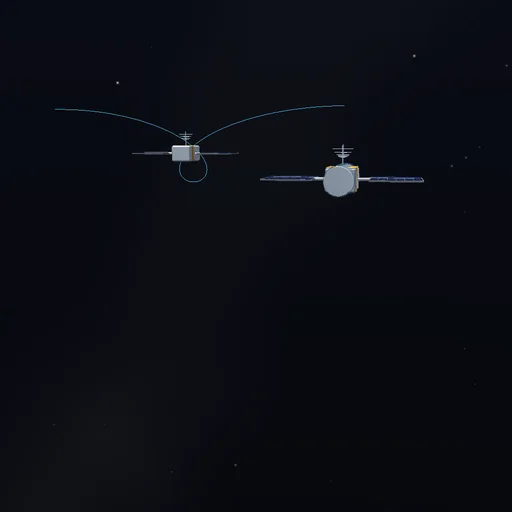
Rendezvous in a moving frame

Give a nearby spacecraft a radial offset and an along-track impulse. Watch the curved relative path and find a closed formation orbit.

Sailing on sunlight — Actual application image

Astronomy

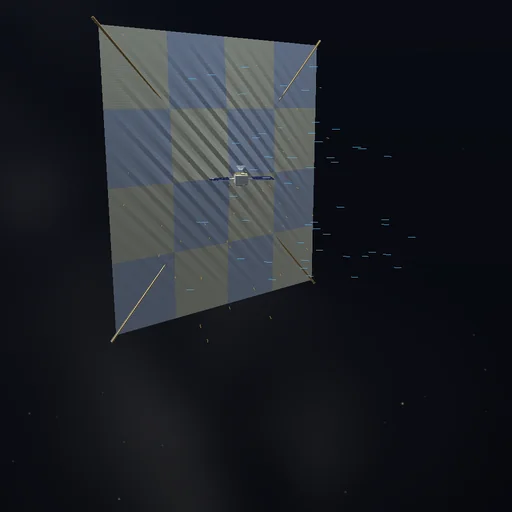
Sailing on sunlight

Tilt a reflecting sail. Resolve photon pressure into radial and tangential thrust and find the angle that gives the strongest sideways push.