Engineering
Crash sled and crumple zones
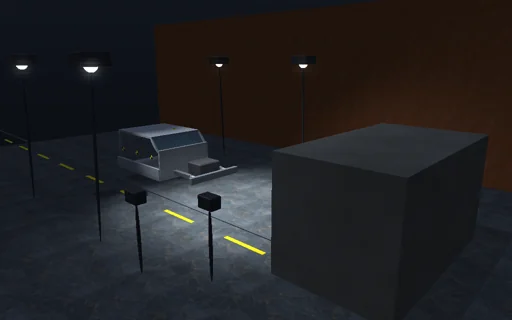
Tow a car into a concrete barrier under the floodlights of a crash hall and watch it in slow motion. The two crash boxes fold lobe by lobe at the mean force the Abramowicz-Jones formula gives for their wall thickness and width; at fifteen kilometres an hour they take all the energy and the car stops exactly where the folding work equals its kinetic energy. At fifty-six the rails behind them fold too, at eighty the engine block bottoms on the barrier and the deceleration soars. The belted dummy slides through the slack before the belt takes him - give the belt more slack and his peak deceleration and head injury criterion rise. Every joule is followed into the folds, the belt and the rebound.
What happens
A 1300 kg car with a 75 kg belted occupant meets a rigid barrier. Two square steel crash boxes, 70 mm wide with 2 mm walls of 300 MPa, fold at the Abramowicz-Jones mean force 13.06 sigma0 t^(5/3) C^(1/3) each, rippling once per lobe of half-wavelength 0.99 t^(1/3) C^(2/3) with an initial buckling peak; only 73 % of a tube can fold. Behind them the rails fold at 300 kN over 0.7 m and the engine block then bottoms on a stiff stop. The occupant slides through the belt slack before the belt, 100 kN/m with 60 % hysteresis, stops him; HIC15 comes from his deceleration. Explicit steps of 20 µs; the kinetic energy is followed into folding, the belt and what is left.
Try this
Crash at 15 km/h and compare the crush with the closed-form folding work; go to 56 and see the rails fold; give the belt more slack and watch the dummy’s peak and HIC rise; try 80 km/h.
The model and its limits
A one-dimensional car and occupant, a folding force law without strain-rate effects, a linear belt with constant hysteresis, no airbag, no rotation of the body. Decelerations are those of this idealized test.
Equations used in the module
Equations
F_m = 13.06·σ0·t^(5/3)·C^(1/3),  H = 0.99·t^(1/3)·C^(2/3)
m·a = −F(x) + F_belt,  F_belt = k_b·(x_o − s)  (·(1 − h) unloading)
½·(m + m_o)·v0² = ∫F dx + W_belt + E_k
HIC15 = max (t2 − t1)·(∫a dt/(t2 − t1))^2.5