Engineering
Airship buoyancy and navigation
Fly a six-thousand-cubic-metre helium airship from its mast to another twenty kilometres east, across a north wind. Below pressure height the air ballonet breathes and the static lift is the same at every altitude, exactly m_He (R_He/R_air - 1) g less the weight; above it the gas fills the envelope, the valve vents what expands and the ship floats up to its ceiling. Let the sun superheat the gas for extra lift, drop ballast or add it, and fly a ship too heavy to rise up on its elevator; watch the autopilot crab into the wind so the ground track points at the destination.
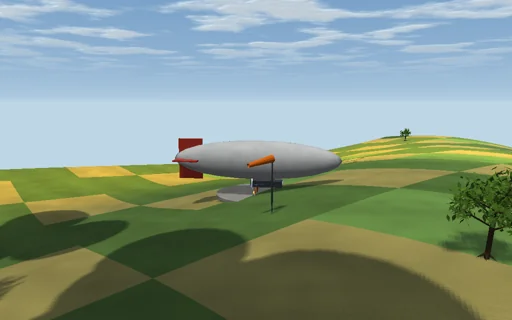
What happens
A 6000 m³ envelope filled 90 % with helium at sea level, with an air ballonet making up the rest, carrying 4.5 t of structure, 600 kg of payload and 400 kg of ballast in the ISA troposphere. Below pressure height the ballonet breathes and the static lift m_He (R_He T_g/(R_air T_a) − 1) g does not depend on altitude; above it the helium fills the envelope and the relief valve vents what expands. Superheat warms the gas; elevator pitch at airspeed adds dynamic lift. The vertical motion includes the added mass of the air; the autopilot crabs into the wind so the ground track points at the destination. RK4 at 0.05 s.
Try this
Watch the ship climb through pressure height and float up to its ceiling; add ballast until it cannot rise and fly it up on the elevator; let the sun superheat the gas; turn the wind and see the crab angle change.
The model and its limits
A point-mass ship in a standard atmosphere, no envelope pressure dynamics, a linear elevator lift, instant heading changes. Lifts and heights are those of this idealized ship.
Equations used in the module
Equations
L_s = (ρ_a·min(V_g, V_env) − m_He − m)·g,  V_g = m_He·R_He·(T + ΔT)/p
L_s = m_He·(R_He/R_air − 1)·g − m·g  (below pressure height)
M_v·a = L_s + ½·ρ·V²·S·C_L·δ − ½·ρ·C_v·A·w·|w|,  M_v = m + m_He + ρ·V_b + k·ρ·V
v_ground = v_air + w,  heading chosen so v_ground points at the target