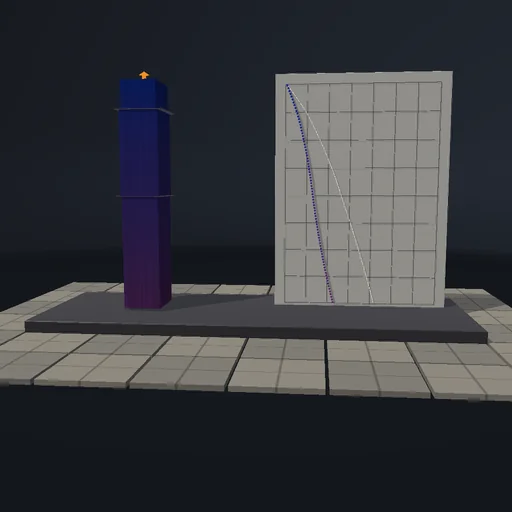
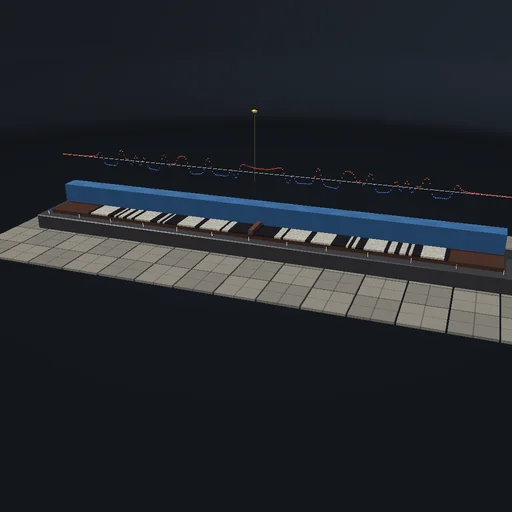
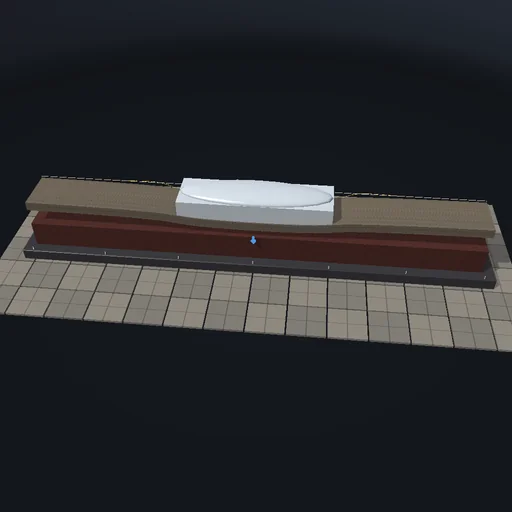
Earth
Metamorphism
Bury a shale at a kilometre per million years down a 25 K/km geotherm, hold it, and lift it back: its point moves across the pressure-temperature grid of facies, chlorite gives way to biotite, garnet and staurolite as the equilibrium shares shift, and because the reaction rate falls a thousandfold between 600 and 400 degrees the peak assemblage is carried to the surface almost untouched, a little more retrograded when the exhumation is slow. Steepen the burial under a cold gradient and the path runs into blueschist; let a pluton heat a shallow rock and it bakes to hornfels; hold a sample isothermal and its shares relax on the closed-form exponential.
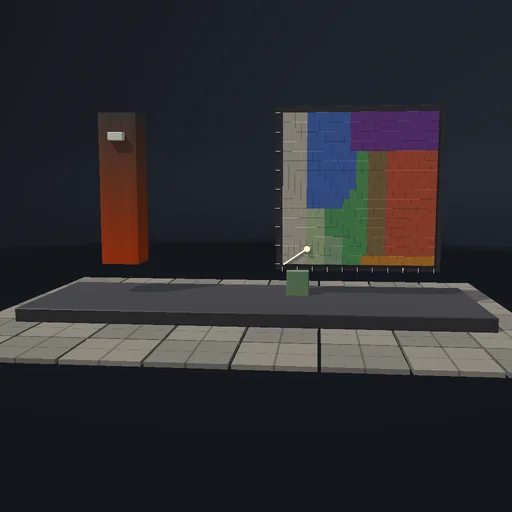
What happens
A rock parcel on a burial, hold and exhumation path: pressure from the overburden, temperature from a linear geotherm with an optional contact pulse decaying over half a million years, a schematic facies grid in temperature and pressure, and five pelitic index minerals whose equilibrium shares are smooth temperature windows summing to one, relaxed towards equilibrium at an Arrhenius rate of 10 per Myr at 600 °C with 200 kJ/mol. The relaxation is exact over each sub-step, so the peak assemblage survives a fast exhumation while a slow one retrogrades a little, and an isothermal step lands on the closed form. One second of the experiment is one Myr.
Try this
Follow the point across the facies grid and the mineral bars shift; compare a fast and a slow return; run a cold deep path into blueschist and a shallow hot one into hornfels.
The model and its limits
A schematic facies grid and five minerals with smooth windows, one Arrhenius rate for every reaction, a linear geotherm without transient conduction, no fluids or deformation. A teaching path, not a petrogenetic grid.
Equations used in the module
Equations
P = ρ·g·z,  T = T_s + G·z + ΔT_0·e^(−(t − t_c)/τ)
df_i/dt = r(T)·(f_i^eq − f_i),  r = r_600·exp(−(E/R)·(1/T − 1/873 K))
f_i^eq ∝ ¼·(1 + tanh((T − T_lo)/w))·(1 − tanh((T − T_hi)/w)),  Σ f_i^eq = 1
f(t) = f^eq + (f_0 − f^eq)·e^(−r·t)